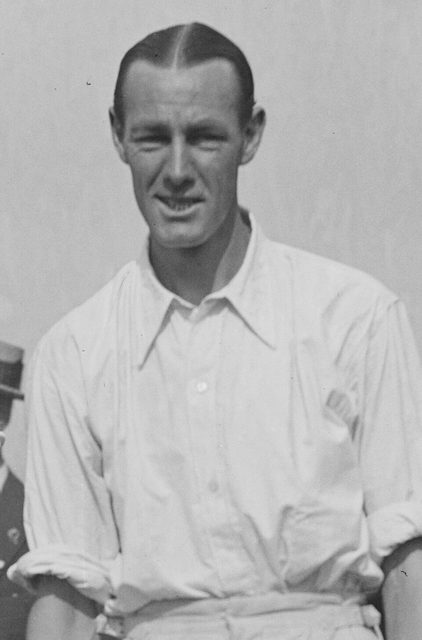
Height, with the speed that earned him the name The Greyhound
Playing career
James Outram Anderson, known as J.O. to the public and Jim to his friends, was born at Enfield in Sydney in 1894 and educated at Camden Grammar School. In 1912 he became the first player from another state to win the Victorian schoolboys' singles, and in 1914 he won the New South Wales singles. He farmed at Forbes during the First World War and won the state title again in 1919.
He played for Australasia and then Australia in 15 Davis Cup ties between 1919 and 1925, including the 1919 Challenge Round in Sydney, won against the British Isles with Patterson, and the Challenge Rounds in New York in 1922 and 1923; in 1923 he handed Bill Johnston his first Davis Cup defeat. He won the Australasian singles in 1922, 1924 and 1925, all three times against Australians, and the doubles with Norman Brookes in 1924. At Wimbledon he reached the singles semi-finals in 1922 and 1925 and won the 1922 doubles with Randolph Lycett, his only important title abroad.
Long overseas tours cost his business money, and when the Lawn Tennis Association of Australia refused to reimburse him he declined to play the 1924 Davis Cup. He set up J.O. Anderson and Co., a chain of sports shops of which only the Pitt Street store survived, turned professional in December 1926 and coached in Sydney; an attempt to regain amateur status in 1930 failed. He later coached at The Entrance into the 1960s and died at Gosford on 23 December 1973, aged 79. He entered the International Tennis Hall of Fame in 2013 and the Australian Tennis Hall of Fame in 2023.
On grass
Australasian singles finals
1922 at White City, Sydney: beat Gerald Patterson 6-0, 3-6, 3-6, 6-3, 6-2. 1924 in Melbourne: beat Richard Schlesinger 6-3, 6-4, 3-6, 5-7, 6-3. 1925 at White City: beat Patterson 11-9, 2-6, 6-2, 6-3
Wimbledon doubles 1922
With Randolph Lycett, beat Pat O'Hara Wood and Gerald Patterson 3-6, 7-9, 6-4, 6-3, 11-9, from two sets down
Wimbledon singles semi-finals
1922: lost to Gerald Patterson, the eventual champion, 6-1, 3-6, 7-9, 6-1, 6-3. 1925: lost to René Lacoste, the eventual champion, 6-4, 7-5, 6-1
Davis Cup 1923
Challenge Round on grass at the West Side Tennis Club, New York: as captain, beat Bill Johnston 4-6, 6-2, 2-6, 7-5, 6-2, Australia's only point in a 4-1 defeat; lost to Bill Tilden, and with John Hawkes lost the doubles to Tilden and Norris Williams 17-15, 11-13, 2-6, 6-3, 6-2
Australasian doubles finals lost
1919 with Arthur Lowe, 1922 with Norman Peach, 1925 with Fred Kalms and 1926 with Pat O'Hara Wood
Leading grass titles only: the grass majors, tour-level grass events since 1968 and the leading grass championships before 1968. † single source; ‡ sources disagree. Roll of champions
"If you were going to write a book on a gentleman, start with JO."
Anecdotes
The person behind the player.
On court
The kangaroo mascot
In Australia he was celebrated for the large toy kangaroo he brought on court as a mascot. He was tall and angular, with his hair parted flat down the middle, and he was often seen as the typical colonial figure.
Bill Tilden described him as "tall, ungainly, almost awkward, taciturn, grim, unsmiling", giving "the impression of ruthlessness in plan", an impression often softened by "his charming smile and generous acknowledgment of his opponent's good shots".
Time magazine reported that "Captain James O. Anderson of the Australian challengers administered to William M. Johnston his first defeat" in Davis Cup play. The win lifted Anderson to third in the world rankings.
After three years of tours lasting five to seven months, he asked the Lawn Tennis Association of Australia to cover his business losses. It refused, and he declined to play the Davis Cup in 1924, putting his energy into a chain of sports shops instead.
As a professional he endorsed racquets made by the Alexander Patent Racket Company of Launceston, Tasmania, which sold a range under his name from 1929 to 1934.
Fellow players called him Gentleman Jim. He kept coaching into the 1960s at The Entrance, on the New South Wales Central Coast, and was described in old age as quick-witted and very spry. In 2023 Tennis Australia announced a bronze statue of him by Barbara McLean for Melbourne Park.