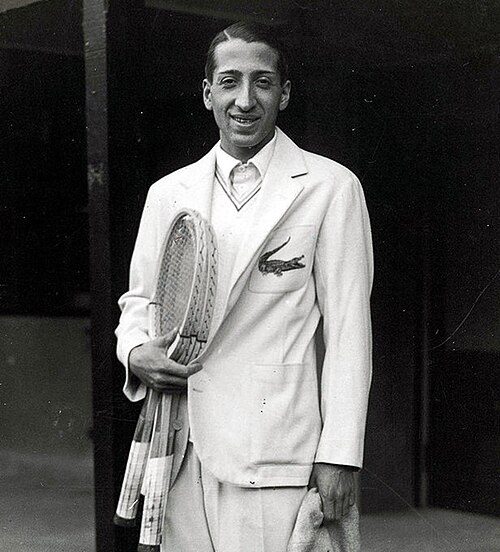
Born in Paris in 1904, Lacoste won seven major singles titles in five years: the French Championships in 1925, 1927 and 1929, Wimbledon in 1925 and 1928, and the US Championships in 1926 and 1927. He also won three major doubles titles with Jean Borotra. A baseliner who kept detailed notes on every opponent, he was ranked world No. 1 by A. Wallis Myers for 1926 and helped France win the Davis Cup in 1927 and 1928. Respiratory illness ended his competitive career in 1929, after one last French title, and he captained the Davis Cup team in 1932 and 1933. In 1933 he co-founded La Société Chemise Lacoste with André Gillier, and in 1963 he introduced a steel racket. He married the golf champion Simone Thion de la Chaume in 1930 and died at Saint-Jean-de-Luz in 1996.
On grass
Major singles titles
4: Wimbledon (1925, 1928); US (1926, 1927)
Major singles finals lost
1: Wimbledon 1924
Major doubles titles
1 doubles (Wimbledon 1)
Wimbledon finals
1924: lost to Jean Borotra 6-1, 3-6, 6-1, 3-6, 6-4. 1925: beat Borotra 6-3, 6-3, 4-6, 8-6. 1928: beat Henri Cochet 6-1, 4-6, 6-4, 6-2
Wimbledon doubles
1925 with Jean Borotra, beating Ray Casey and John Hennessey 6-4, 11-9, 4-6, 1-6, 6-3
US Championships
Champion 1926, beating Jean Borotra in the final, and 1927, beating Bill Tilden 11-9, 6-3, 11-9 at Forest Hills. Mixed doubles finalist 1926 and 1927 with Hazel Hotchkiss Wightman
Davis Cup on grass
1927 Challenge Round, Germantown Cricket Club, Philadelphia: beat Bill Johnston 6-3, 6-2, 6-2 and Bill Tilden 6-3, 4-6, 6-3, 6-2; France won 3-2
Leading grass titles only: the grass majors, tour-level grass events since 1968 and the leading grass championships before 1968. † single source; ‡ sources disagree. Roll of champions
"That Frenchman is a machine."
Anecdotes
The person behind the player.
Boston 1923
The crocodile valise
During a Davis Cup tie against Australia he admired a crocodile-skin valise in a shop window. The French captain, Allan Muhr, promised to buy it if Lacoste won his opening rubber against James Anderson. He lost in straight sets, but the sportswriter George Carens told the story and the nickname stuck. The earliest American use found in print dates from 1925.
Opponents found that he sent almost every ball back, and he was called a human ball machine. He also built a real one: the first hand-cranked ball machine, which he named the lance-balle. It suited a player known for his fitness, his preparation and the written notes he kept on every opponent.
From his early tournaments he wrote down how each opponent played. According to the writer John Tunis, he studied ballistics, spin and the flight of the ball, and worked out court angles with trigonometry in his notebooks. He kept eight to ten rackets in rotation and refused to be distracted by equipment, officials or weather.
Tilden called him unsmiling, drab and almost dull, and wished he would just once show some form of human reaction; he also called him shrewd, analytical and superb in technique. Jean Borotra, beaten by him on indoor wood that year, offered a dry apology to the crowd: "Excuse me, please, from Mr. Lacoste."
A week after the Davis Cup he beat Manuel Alonso and Bill Johnston, then Tilden 11-9, 6-3, 11-9 in the final, surviving set points along the way. Tilden had held the American title from 1920 to 1925. Allison Danzig wrote that Tilden had been "outguessed, outgeneraled, and outstroked".
His friend Robert George drew a crocodile that Lacoste wore on his blazer at tournaments. In 1933 he and André Gillier founded La Société Chemise Lacoste to sell the tennis shirt, with the crocodile on the chest, that he had introduced in 1929. In 1963 he brought out a steel racket, sold in the United States as the Wilson T-2000 and used by Billie Jean King and Jimmy Connors.