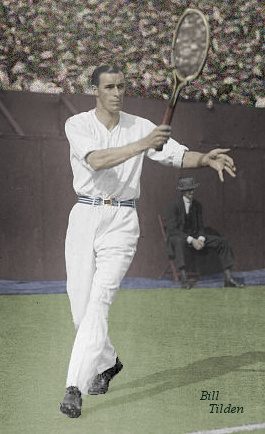
Born in Germantown, Philadelphia, in 1893, Tilden stood 1.87 metres and was known as Big Bill. He won his first major at 27, when he became the first American man to win Wimbledon in 1920, and went on to win the US Championships seven times and Wimbledon three times. He was ranked world No. 1 six years running from 1920 to 1925, and helped the United States win seven consecutive Davis Cups. He wrote more than 20 books on tennis and spent much of his income on plays and Broadway shows in which he acted. He turned professional in 1931 and was inducted into the International Tennis Hall of Fame in 1959. His later life was marked by convictions in 1946 and 1949, both followed by prison terms. He died in Los Angeles in 1953.
Leading grass titles only: the grass majors, tour-level grass events since 1968 and the leading grass championships before 1968. † single source; ‡ sources disagree. Roll of champions
"Never give a player a shot he likes to play."
Anecdotes
The person behind the player.
Wimbledon 1920
King of the Courts
At 27 and without a major title, Tilden arrived for his first Wimbledon and came through a close five-setter against A.R.F. Kingscote. In the Challenge Round he lost the first set to the holder, Gerald Patterson, then attacked his backhand and dropped nine games in the next three sets. English crowds took to his daring and named him King of the Courts.
Spectators queued from 4am for the Challenge Round. Brian Norton took the first two sets, and at 4-4 in the fifth reached match point on Tilden's serve. Tilden's shot landed on the line, Norton's reply went out by inches, and Tilden won 7-5. A rumour went round that he had bet he could give away two sets and still win; nobody ever proved it.
Tilden won his only Wimbledon doubles title with Frank Hunter, against the holders Jacques Brugnon and Henri Cochet. The French pair led 6-1, 6-4 before the Americans took the last three sets 8-6, 6-3, 6-4. A year later Tilden beat Hunter in the final of the London Championships at West Kensington.
The US Lawn Tennis Association suspended Tilden for being paid to file newspaper reports during Wimbledon. The French federation, which had built Roland Garros partly in expectation of a tie against him, asked for help, and President Calvin Coolidge backed his reinstatement for the Davis Cup final. He played, but was not allowed to captain the team, which lost 4-1.
What Tilden wanted most was to act and to write. He appeared in films and plays, and wrote, produced and starred in Broadway shows that he paid for largely out of his own earnings. Sports Illustrated later noted that most of the plays were flops. The tennis books, more than 20 of them, fared better.
Nine years after his second title, and after three straight semi-final defeats, Tilden won Wimbledon for a third time, beating his compatriot Wilmer Allison 6-3, 9-7, 6-4. At 37 he was the oldest man to win the singles at that point. He turned professional the following year.