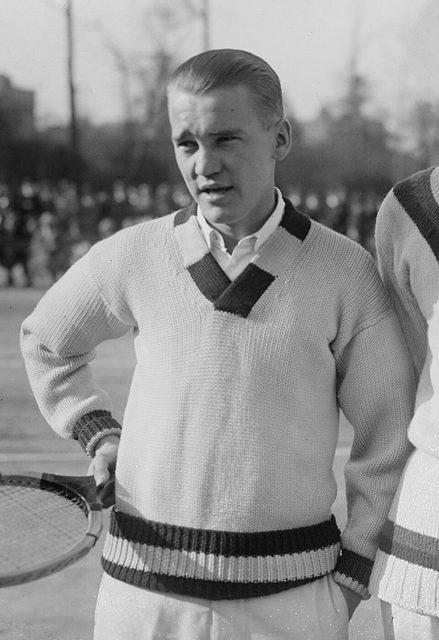
US Championships singles semi-finals, 1922 to 1926
4
Davis Cup wins with the United States
Playing career
Born in Yonkers on 20 March 1903, Richards won the US doubles title with Bill Tilden in 1918 at 15, still the youngest man to win a major championship. He studied at Fordham and the Columbia School of Journalism, and as an amateur won seven major men's doubles titles, among them Wimbledon in 1924 and the French in 1926 with Howard Kinsey. In 1924 he won Olympic gold in singles and doubles in Paris and was ranked world No. 2 by A. Wallis Myers. He played in four winning Davis Cup teams between 1922 and 1926, then turned professional with C. C. Pyle's tour in 1926. He helped organise the US Pro Championships, won the singles four times, and later became a vice president of Dunlop. He died in 1959 and entered the Hall of Fame in 1961.
On grass
Other grass singles titles
10: US Pro Championships 4 (1927, 1928, 1930, 1933); Southampton 3 (1920, 1922, 1923); Seabright 2 (1925, 1926); Queen's (1923)
Major doubles titles
6 doubles (Wimbledon 1, US 5), 2 mixed (US 2)
Other grass doubles titles
4: US Pro Championships 4 (1929, 1930, 1931, 1933)
Wimbledon doubles
Champion 1924 with Frank Hunter, beat Watson Washburn and R. Norris Williams 6-3, 3-6, 8-10, 8-6, 6-3. Finalist 1926 with Howard Kinsey, lost 5-7, 6-4, 3-6, 2-6 to Jacques Brugnon and Henri Cochet
US doubles
1918, 1921 and 1922 with Bill Tilden; 1925 and 1926 with R. Norris Williams. Finalist 1919 with Tilden
US mixed
1919 with Marion Zinderstein; 1924 with Helen Wills. Finalist 1925 with Ermyntrude Harvey
Singles at the grass majors
US Championships semi-finals 1922, 1924, 1925 and 1926; Wimbledon quarter-final 1924
Davis Cup on grass
1924 challenge round, Germantown Cricket Club: won both his singles against Australia
Finals to remember
US doubles 1918, aged 15, with Tilden: beat Fred Alexander and Beals Wright 6-3, 6-4, 3-6, 2-6, 6-2
Leading grass titles only: the grass majors, tour-level grass events since 1968 and the leading grass championships before 1968. † single source; ‡ sources disagree. Roll of champions
"I figure I played about 14,000 matches, and in each one I ran about four and a half miles. That means I ran 56,000 miles or about twice around the world."
Anecdotes
The person behind the player.
US Championships 1918
The Boy Wonder of Tennis
Aged 15, he partnered Bill Tilden in the men's doubles final and won in five sets over Fred Alexander and Beals Wright. No younger man has won a major title. He was dubbed the "Boy Wonder of Tennis", and Yonkers, 20 miles from Forest Hills, later called him its pride.
He stayed amateur for ten years partly to play the Olympics, and in Paris he took gold in singles, beating Henri Cochet in five sets, gold in doubles with Frank Hunter over Cochet and Jacques Brugnon, and silver in mixed with Marion Zinderstein Jessup. Tennis then left the Games until 1988.
At 23, the only one of the recent Davis Cup defenders under 32, he signed for C. C. Pyle's professional tour with Suzanne Lenglen. The signing was announced at a banquet on board ship, and the guests applauded when he and his wife came in. "I intend to play just as hard as when I was an amateur," he said.
The national ranking committee had placed him top American for 1926. In February the association voted to take away the new professionals' amateur rankings. Richards answered by promising to lead "honest professionals" against the "sham amateurs" and the "New York clique", which cost him friends. Tilden, who had backed the pro idea, attacked him in print.
On the four-month North American tour he usually won his singles, often in three sets, and the crowds applauded his volleys most of all. In New Orleans he fell ill with suspected jaundice and had to stop for a time. He told reporters professional tennis would succeed, and that autumn he won the first US Pro title, beating Howard Kinsey in the final.
After his playing days he joined Dunlop and became vice president of its sporting goods division. For his 50th birthday the Yonkers Herald Statesman gave him a full-page photograph and tribute on 23 March 1953, calling him the Pride of Yonkers. He died six years later, aged 56, in New York.