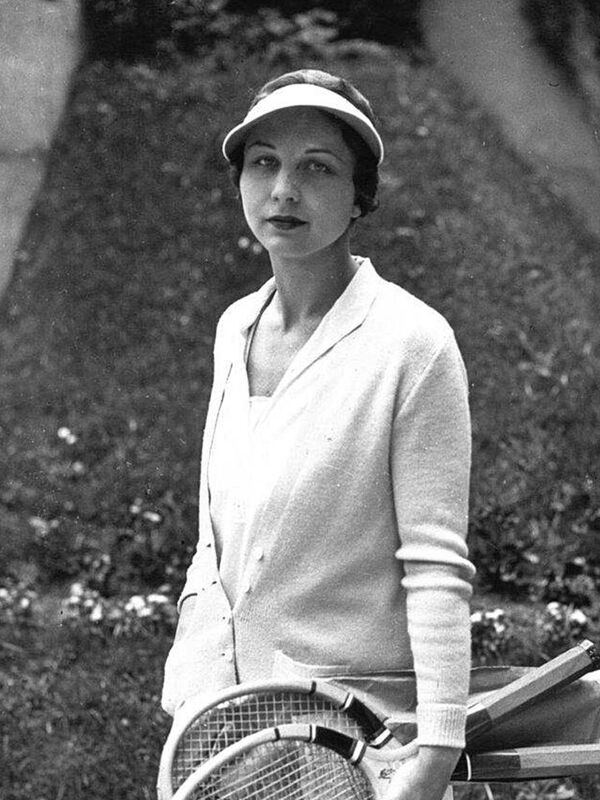
Born in Centerville, California, in 1905, Wills learnt the game largely by watching and by practising against men on the West Coast. She won the US Championships in 1923, aged 17, then the youngest champion, and in 1924, while a student at the University of California, Berkeley, took Olympic gold in singles and doubles in Paris. Between 1923 and 1938 she won 19 major singles titles: eight at Wimbledon, seven at the US Championships and four at the French. From 1927 to 1933 she won 161 matches in a row, 141 of them without losing a set. She played as Helen Wills Moody after her marriage in 1929, painted and exhibited throughout her life, and entered the Hall of Fame in 1959. She died in Carmel, California, in 1998, aged 92.
4: Irish Championships (1938); Kent (1927); Longwood (1925); Seabright (1931)
Major doubles titles
7 doubles (Wimbledon 3, US 4), 3 mixed (Wimbledon 1, US 2)
Wimbledon finals won
1927 and 1928: beat Lilí de Álvarez. 1929, 1932, 1935 and 1938: beat Helen Jacobs. 1930: beat Elizabeth Ryan 6-2, 6-2. 1933: beat Dorothy Round 6-4, 6-8, 6-3
Wimbledon final lost
1924: to Kitty McKane 4-6, 6-4, 6-4, her only singles defeat at Wimbledon
Wimbledon doubles and mixed
Doubles 1924 with Hazel Wightman, 1927 and 1930 with Elizabeth Ryan. Mixed 1929 with Frank Hunter
Final to remember
Wimbledon 1935: saved a match point at 2-5 down in the third set and beat Helen Jacobs 6-3, 3-6, 7-5
US Championships 1933
Retired at 0-3 in the third set of the final against Helen Jacobs, ending a run of 45 match wins at the event
Wightman Cup
Played in ten ties between 1923 and 1938; 20 matches won, 9 lost
Leading grass titles only: the grass majors, tour-level grass events since 1968 and the leading grass championships before 1968. † single source; ‡ sources disagree. Roll of champions
"When she steps on a tennis court, all but the game ceases to exist."
Anecdotes
The person behind the player.
Cannes 1926
The Match of the Century
Her only meeting with Suzanne Lenglen, at the Carlton Club in February 1926, drew King Gustaf V of Sweden to the stands. Lenglen won 6-3, 8-6. Wills had a set point in the second set but a linesman ruled against her, and she protested, a rare show of feeling. Afterwards she asked a reporter: "Don't you feel she should have given me a return match here?"
Ed Sullivan, then a sportswriter, called the teenager "Little Poker Face" in 1922, and the name grew into Little Miss Poker Face. She did not mind it. "I considered it a compliment," she said in 1952, "because composure is the greatest asset you can have in sports." Her white visor, worn from her junior days, set a fashion of its own.
Before her first trip to Europe she practised against men, among them Bill Johnston, who hit their hardest shots at her; she sent most of them back. In 1929 she beat Fritz Mercur in a practice match, and he needed a rematch to take two sets off her. Lenglen, by contrast, avoided practice with men as she grew older.
In the US final she trailed Helen Jacobs 0-3 in the third set and retired with a back injury, ending a run of 45 matches won at the Championships. Some questioned whether she had denied Jacobs a full win. Jacobs called their relationship one of incompatibility, not a feud. Two years later Wills saved a match point against her and won the Wimbledon final.
Diego Rivera chose her as the model for Calafia, the Spirit of California, in his fresco Allegory of California, painted in 1931 for the Pacific Stock Exchange Lunch Club. It was his first fresco in the United States. Wills, who had graduated from Berkeley in fine arts, painted and drew all her life and illustrated her own coaching book.
Alice Marble said before the Championships that Wills was no longer the best player in the world. Hilde Sperling took her to 12-10, 6-4 in the semi-final, but in the final Jacobs hurt her ankle and Wills won 6-4, 6-0 for her eighth title. She did not play Wimbledon again.