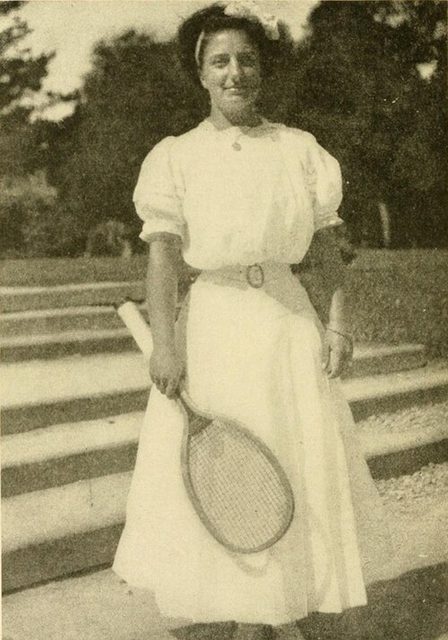
Born in Healdsburg, California, in 1886, Hazel Hotchkiss took up tennis at 16 and learned the game on the courts of the University of California, Berkeley, graduating in 1911. She won the US Championships singles, doubles and mixed in each of 1909, 1910 and 1911, and a fourth singles title in 1919. In 1912 she married George Wightman of Boston. She won 16 US Championships titles in all, the 1924 Wimbledon doubles with Helen Wills, and Olympic gold in doubles and mixed in Paris the same year. She founded the Wightman Cup between the United States and Great Britain, first played in 1923, and captained the American side 13 times. She was elected to the International Tennis Hall of Fame in 1957, made an honorary CBE in 1973, and died in 1974.
On grass
Major singles titles
4: US (1909, 1910, 1911, 1919)
Major singles finals lost
1: US 1915
Other grass singles titles
3: Longwood Bowl 3 (1911, 1913, 1919)
Major doubles titles
7 doubles (Wimbledon 1, US 6), 6 mixed (US 6)
Titles kept in a challenge round
2: US (1910, 1911). Scored as a final won, not a full draw (-8 points).
US doubles
1909 and 1910 with Edith Rotch; 1911 and 1915 with Eleonora Sears; 1924 and 1928 with Helen Wills
US mixed
1909, 1911 and 1920 with Wallace Johnson; 1910 with Joseph Carpenter; 1915 with Harry Johnson; 1918 with Irving Wright. Finals lost 1926 and 1927 with René Lacoste
Wimbledon
1924 doubles with Helen Wills, beating Phyllis Covell and Kitty McKane 6-4, 6-4, at her only Wimbledon, where she reached the third round of the singles
Finals to remember
US 1911, Philadelphia Cricket Club: beat Florence Sutton 8-10, 6-1, 9-7. US 1915: lost to Molla Bjurstedt 6-4, 2-6, 0-6
Wightman Cup
Founded the contest, first played on grass at Forest Hills in 1923, when the United States won 7-0. Played in 1923, 1924, 1927, 1929 and 1931
Leading grass titles only: the grass majors, tour-level grass events since 1968 and the leading grass championships before 1968. † single source; ‡ sources disagree. Roll of champions
"I have never been able to be anywhere without teaching tennis."
Anecdotes
The person behind the player.
California, 1900s
Volleys against the house
A doctor recommended a sport to strengthen her, and her brother suggested tennis as a genteel one. She practised volleying against the family house and refused to let the ball bounce, because the yard was too uneven for a true bounce. She became one of the first women to rely heavily on the volley.
In the final of the Niagara International against May Sutton she lost the first set 6-0 and trailed 5-1 in the second. She then won 12 games in a row to take the title 0-6, 7-5, 6-0. The rivalry with Sutton, forehand power against her attack at the net, helped shape a new women's game.
Sutton did not take defeat quietly; after one loss she was heard to call Wightman's game "Stinkpot tennis!" Before a later meeting a gentleman warned the players: "If any of you ladies have spikes, you ought to wear them. The grass is very damp out there." Wightman put hers on. Sutton replied: "I don't need spikes."
For a woman who coached three generations, she never had a coach herself. "Nobody ever gave me a lesson," she told American Heritage at 87. "If somebody would have taught me, I never would have learned to make a half volley." She taught in slow motion and by demonstration, and swore by the bangboard in her garage.
The silver vase played for by American and British women from 1923 was known to all as the Wightman Cup. She pointed out in 1974 that the engraving reads otherwise: "It says International Trophy, but nobody knows that." Her idea had been simple: "wouldn't it be fun to have Suzanne Lenglen and other foreigners come here to play."
Her home near the Longwood Cricket Club was open to aspiring champions, and she gave free instruction to many. She was known for her sportsmanship and was called the Queen Mother of American Tennis. In 1973 Queen Elizabeth II made her an honorary CBE, the year before she died at home at the age of 87.