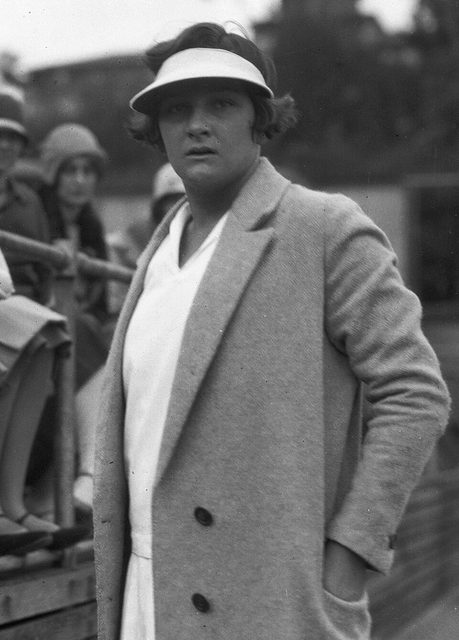
Born in Globe, Arizona, on 6 August 1908, Jacobs grew up in Berkeley, California, where she trained at the Berkeley Tennis Club under William "Pop" Fuller and later studied at the University of California. She won the US Championships four years running from 1932 to 1935 and Wimbledon in 1936, the year she was ranked world No. 1. Helen Wills Moody beat her in six major finals. She won three US doubles titles and the 1934 US mixed. She played Wightman Cup for the United States from 1927 to 1939. In 1943 she joined the WAVES, the women's naval reserve, served in naval intelligence and retired as a commander. She wrote about 20 books and entered the Hall of Fame in 1962.
On grass
Major singles titles
5: Wimbledon (1936); US (1932, 1933, 1934, 1935)
Major singles finals lost
9: Wimbledon 1929, Wimbledon 1932, Wimbledon 1934, Wimbledon 1935, Wimbledon 1938, US 1928, US 1936, US 1939, US 1940
1936: beat Hilde Krahwinkel Sperling 6-2, 4-6, 7-5, in a year Helen Wills Moody did not enter
Wimbledon finals lost
1929 to Wills 1-6, 2-6; 1932 to Wills Moody 3-6, 1-6; 1934 to Dorothy Round 2-6, 7-5, 3-6; 1935 to Wills Moody 3-6, 6-3, 5-7 after holding match point; 1938 to Wills Moody 4-6, 0-6
US final 1933
Led Wills Moody 8-6, 3-6, 3-0 at Forest Hills when Wills Moody retired: her only win over her rival
US doubles
1932, 1934 and 1935 with Sarah Palfrey; mixed 1934 with George Lott
Wightman Cup
Played for the United States from 1927 to 1937 and in 1939, with a record of 19 wins and 11 losses
Leading grass titles only: the grass majors, tour-level grass events since 1968 and the leading grass championships before 1968. † single source; ‡ sources disagree. Roll of champions
"Nothing but prejudice has prevented our wearing them for years."
Anecdotes
The person behind the player.
Berkeley, 1920s
Same house, same club
Both Helens learned the game at the Berkeley Tennis Club under the same coach, Pop Fuller, and both went to the University of California. The Jacobs family even moved into the house the Wills family had lived in. The two hardly spoke. Wills, reserved, was Little Miss Poker Face; Jacobs was the more outgoing of the pair.
In 1929 she planned to play Wimbledon without stockings and thought better of it when a ban was threatened. By 1933 she was playing in shorts at Forest Hills, saying they were cool and comfortable and her racquet no longer caught in her skirt. She called them "really a tremendous advantage".
In the US final Jacobs took the first set 8-6, the first set she had ever won from Wills. At 3-0 to Jacobs in the third, Wills put on a sweater and retired, citing pain in her back and hip. Jacobs later wrote that Wills's temperament, usually her greatest asset, was that day her greatest liability.
In the final she led Wills Moody 5-3 in the third set and reached match point. Wills Moody threw up a short lob; Jacobs let it bounce, then mishit it. Wills Moody won the last four games and the title 6-3, 3-6, 7-5.
Jacobs turned her ankle at 4-4 in the first set of the final and chose not to retire. Wills Moody won the last eight games. Five years after the Forest Hills default, it was Wills Moody who offered the sympathy: she said afterwards that she was "very sorry about Helen's ankle".
She left tennis in 1943 to join the WAVES and served as a naval intelligence officer in Washington. She returned to active duty during the Korean War and retired as a commander, one of five women to reach that rank. Her novel By Your Leave, Sir told the story of a WAVE.