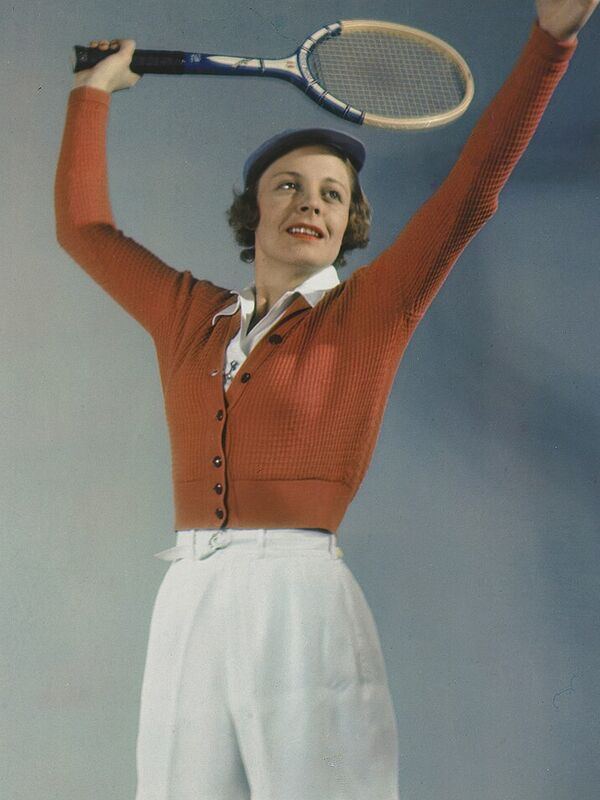
Born in Beckwourth, California, on 28 September 1913, Marble played baseball, basketball and boxed as a girl before settling on tennis at 15. Coached from 1932 by Eleanor Tennant, she collapsed on court in Paris in 1934 and spent two years recovering before winning the US Championships in 1936. She won the US singles four times, in 1936 and from 1938 to 1940, and Wimbledon in 1939, and was ranked world No. 1 that year. She was Associated Press Athlete of the Year in 1939 and 1940. She turned professional after the 1940 season and toured with Don Budge and Bill Tilden. She later taught tennis, counted Billie Jean King among her pupils, and entered the Hall of Fame in 1964. She died in Palm Springs in 1990.
Leading grass titles only: the grass majors, tour-level grass events since 1968 and the leading grass championships before 1968. † single source; ‡ sources disagree. Roll of champions
"Alice Marble was a picture of unrestrained athleticism."
Anecdotes
The person behind the player.
San Francisco, 1920s
A pretty good arm
Baseball was her first love, and as a girl she was good enough to work out with the minor league San Francisco Seals. Joe DiMaggio, who played for the Seals, said of her: "She had a pretty good arm." As a junior tennis player she was known as the Queen of Swat.
After a day of 108 games in 100-degree heat at East Hampton in 1933 ended her season, she collapsed on court in Paris the next spring and spent months in a sanatorium, paid for by her coach Eleanor Tennant. Doctors told her to stop playing. Two years after that advice she was world No. 1.
Few expected her to be ready for the 1936 US Championships. She nearly gave away the first set of the final to Helen Jacobs, who was playing with a strapped right thumb, then won 4-6, 6-3, 6-2 with the Forest Hills gallery behind her. It ended Jacobs's run of four titles.
Marble won all three events she entered at Wimbledon in 1939: the singles, the doubles with Sarah Palfrey Fabyan and the mixed with Bobby Riggs. In the singles final she beat Kay Stammers 6-2, 6-0. Stammers later said she would rather have faced Helen Wills Moody.
In the desert heat of Palm Springs, where she lived with Tennant above a drugstore, Marble often wore shorts, and she kept wearing them as a professional. She drew criticism for choosing them over the tennis skirt that women were expected to wear.
In the 1 July 1950 issue of American Lawn Tennis she wrote an editorial attacking the exclusion of Althea Gibson: "If tennis is a game for ladies and gentlemen, it's also time we acted a little more like gentle-people." Gibson was admitted to the US Championships that summer, the first Black player at a major.