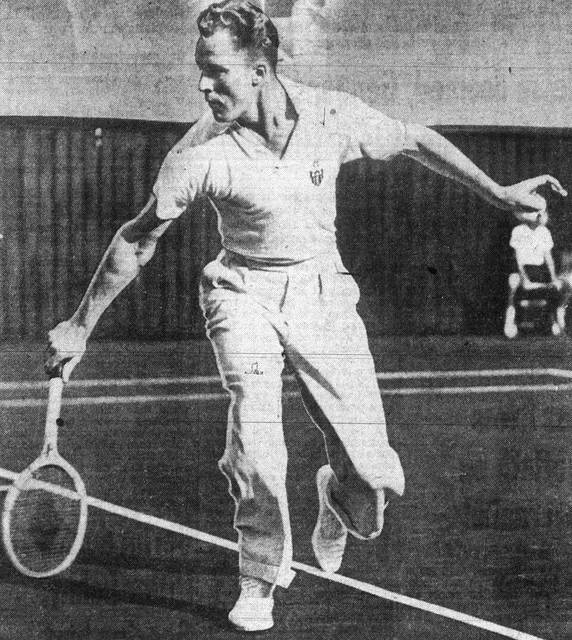
The set he took from Budge in the 1938 US final, the only set Budge lost in the event
6-2
Davis Cup doubles record, 1935 to 1938, with two Cup wins
Playing career
Constantine Gene Mako was born in Budapest in 1916, the son of the painter Bartholomew Mako. After the First World War the family lived in Italy and Argentina before settling in Los Angeles. He won the US boys' singles in 1932 and 1934 and, for the University of Southern California, the NCAA singles and doubles in 1934. Six feet tall, he built his game on a big serve, volleys and overheads, until a fall on an English grass court in 1936 injured his right shoulder and took much of the power away.
With his friend Don Budge he reached seven major doubles finals and won four: the US Championships in 1936 and 1938 and Wimbledon in 1937 and 1938. He won the 1936 US mixed with Alice Marble, played Davis Cup from 1935 to 1938 and won the Cup in 1937 and 1938. In 1938, unseeded, he reached the US singles final and lost to Budge, who completed the first Grand Slam. He was ranked No. 3 in the United States that year. In December 1939 the US association temporarily declared him and Wayne Sabin ineligible over expenses.
He married the actress Laura Mae Church in 1941, served in the US Navy during the Second World War and played briefly as a professional. Afterwards he built tennis courts, ran the Gene Mako Galleries in Los Angeles, wrote a book about his father and taught art. He entered the Hall of Fame in 1973 and died in Los Angeles on 14 June 2013, aged 97.
On grass
Wimbledon doubles finals
With Budge. 1937, seeded second: beat Pat Hughes and Raymond Tuckey 6-0, 6-4, 6-8, 6-1. 1938, top seeds: beat Henner Henkel and Georg von Metaxa 6-4, 3-6, 6-3, 8-6
US doubles finals
With Budge. 1935: lost to Wilmer Allison and John Van Ryn 2-6, 3-6, 6-2, 6-3, 1-6. 1936: beat Allison and Van Ryn 6-4, 6-2, 6-4. 1937: lost to Gottfried von Cramm and Henkel 4-6, 5-7, 4-6. 1938: beat Adrian Quist and John Bromwich 6-3, 6-2, 6-1
US mixed 1936
With Alice Marble beat Budge and Sarah Palfrey Fabyan 6-3, 6-2
Forest Hills 1938
Unseeded, reached the singles final and lost to Budge 6-3, 6-8, 6-2, 6-1
Davis Cup at Wimbledon, 1937
In the Inter-Zone final against Germany at Wimbledon, he and Budge beat von Cramm and Henkel in four sets; the United States went on to beat Great Britain 4-1 for the Cup
Leading grass titles only: the grass majors, tour-level grass events since 1968 and the leading grass championships before 1968. † single source; ‡ sources disagree. Roll of champions
"I told him I'd be serving like a little old lady and would have to shovel the ball around, but it was OK with him."
Anecdotes
The person behind the player.
England, 1936
A fall on the grass
Mako was thought to have one of the best serves in the world until he fell on an English grass court in the summer of 1936 and hurt his right shoulder. "Everybody said I had the best serve and overhead in the world," he told the Los Angeles Times in 2007. "And I went from that to nothing. Mentally, it was a terrible thing."
Mako and Budge were friends and roommates on the road, and some suggested Budge had let him take the second set of the 1938 final. Budge rejected that: "I had too much respect and affection for Gene to treat him as if he were an inferior player who could be given a set for his troubles, rather than a condescending pat on the head." Allison Danzig wrote in The New York Times that there was "no trace of amiability" on either side.
In December 1939 the US Lawn Tennis Association temporarily declared Mako and Wayne Sabin ineligible as amateurs, alleging they had taken living expenses for more than eight weeks of the year and travel money above the approved amounts. The chairman, Louis J. Carruthers, said the association had never before ordered such a temporary suspension.
After the war Mako built private tennis courts and opened the Gene Mako Galleries in Los Angeles, where he gathered much of his father's work. He wrote a book about him, Bartholomew Mako: A Hungarian Master, 1890 to 1970, and in the last decade of his life taught art.