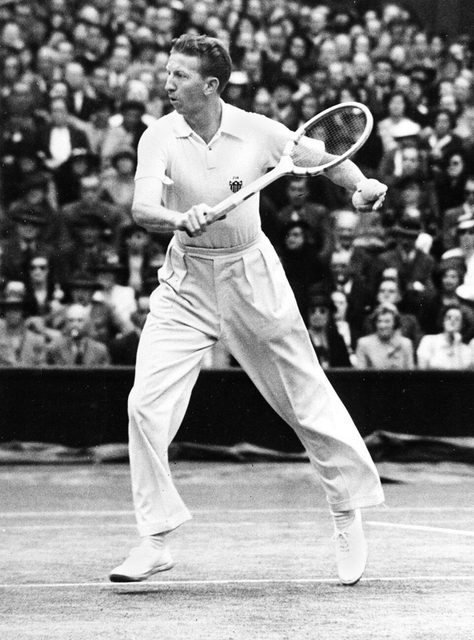
Major singles titles in 1938, the first Grand Slam
8-6
Fifth set against von Cramm, 1937 Davis Cup
25-4
Davis Cup match record, 1935 to 1938
Playing career
Born in Oakland, California, on 13 June 1915, the son of a Scottish former footballer, Budge took up tennis at 13 at his elder brother's urging. He lost the 1936 US final to Fred Perry 10-8 in the fifth set, then won Wimbledon and the US title in 1937 and was the first tennis player to receive the James E. Sullivan Award. In 1938 he won all four majors, the first Grand Slam. He played Davis Cup from 1935 to 1938 and turned professional in October 1938, beating Ellsworth Vines and Perry in head-to-head tours in 1939 and winning the US Pro in 1940 and 1942. A shoulder injury suffered in the US Army Air Forces in 1943 limited him afterwards. He died in Scranton, Pennsylvania, in 2000, and entered the Hall of Fame in 1964.
On grass
Major singles titles
5: Wimbledon (1937, 1938); Australian (1938); US (1937, 1938)
4 doubles (Wimbledon 2, US 2), 4 mixed (Wimbledon 2, US 2)
Other grass doubles titles
3: US Pro 3 (1942, 1947, 1949)
Wimbledon doubles
1937 and 1938 with Gene Mako, winning the finals 6-0, 6-4, 6-8, 6-1 and 6-4, 6-3, 3-6, 8-6
Wimbledon mixed
1937 and 1938 with Alice Marble, beating Yvon Petra and Simonne Mathieu 6-4, 6-1, then Henner Henkel and Sarah Fabyan 6-1, 6-4
Finals to remember
1937 Wimbledon: beat Gottfried von Cramm 6-3, 6-4, 6-2. 1938 Wimbledon: beat Bunny Austin 6-1, 6-0, 6-3 without losing a set all fortnight. 1936 US: lost to Fred Perry 2-6, 6-2, 8-6, 1-6, 10-8
1937 Inter-Zone final on Centre Court: beat von Cramm 6-8, 5-7, 6-4, 6-2, 8-6 from 1-4 down in the fifth set, and the United States went on to win the cup
Leading grass titles only: the grass majors, tour-level grass events since 1968 and the leading grass championships before 1968. † single source; ‡ sources disagree. Roll of champions
"Donald was unstoppable that afternoon, almost unplayable at times."
Anecdotes
The person behind the player.
Wimbledon 1935 · Semi-final
A wave to the Queen
Queen Mary arrived in the Royal Box during the second set of his semi-final against Gottfried von Cramm. At the change of ends the 20-year-old Californian waved to her, which was seen as a severe breach of etiquette. The Queen waved back, and the crowd cheered.
Budge later claimed that von Cramm took a good-luck telephone call from Hitler just before they walked out. Ties were usually played on outer courts, but this one was moved to Centre Court, with Queen Mary watching. After five sets von Cramm told Budge it was absolutely the finest match he had ever played, and that he was glad it was against him.
He won the singles without dropping a set in the final against von Cramm, the doubles with Gene Mako and the mixed with Alice Marble. He did the same again a year later. At the end of 1937 he was named the Associated Press male athlete of the year.
Tall, slim and red-haired, he took up the game at 13, encouraged by his elder brother Lloyd. Within seven years Time magazine had put one of his backhands on its cover, on 2 September 1935, and he went on to feature on a Wheaties box, in Life and Look, and on his own Wilson racquet.
As a professional he played an exhibition in Harlem against Jimmie McDaniel, one of the best African American players of the time. The International Tennis Hall of Fame says the match is believed to have been the first interracial tennis match in the United States.
He began his professional career at Madison Square Garden against Ellsworth Vines and beat him 22-17 on their tour. Fred Perry, who had beaten him in the 1936 US final, fared worse: Budge won their series 28-8. He also took the French Pro and Wembley Pro titles that year.