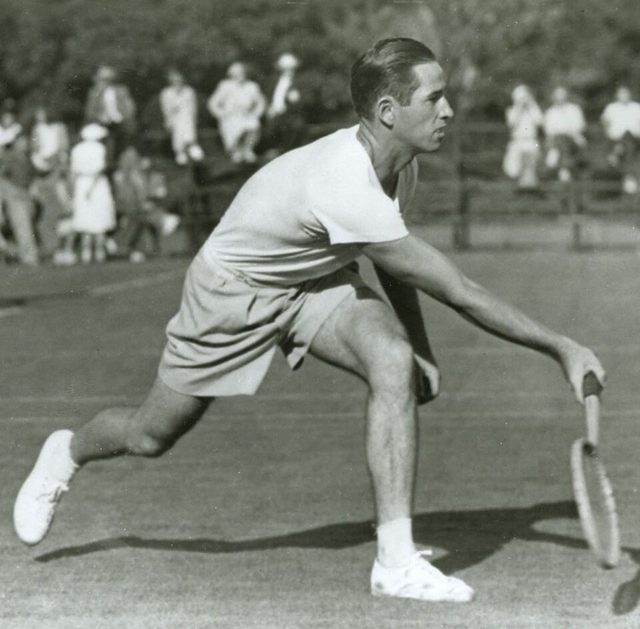
Wimbledon titles in 1939: singles, doubles and mixed, at his first attempt
2
US singles titles at Forest Hills, 1939 and 1941
3
US Pro titles at Forest Hills, 1946, 1947 and 1949, each final against Don Budge
1939
Year ranked world No. 1 amateur
5 ft 7 in
Height; he won with control, speed, the lob and the drop shot
Playing career
Robert Larimore Riggs was born in Los Angeles on 25 February 1918, one of six children of a minister. He was a fine table tennis player as a boy and took up tennis at about 12. Perry Jones, who ran Southern California tennis, thought him too small, so Riggs relied on other backers. He won the US National Juniors in 1935 and, still a junior, the US Clay Court Championships and the Newport Casino tournament in 1936, finishing the year ranked fourth in the United States.
He was on the American team that won the Davis Cup at Germantown in 1938. In 1939 he lost the French final to Don McNeill, then won the singles, doubles and mixed at Wimbledon and the US title at Forest Hills, and was ranked world No. 1 amateur. He lost the 1940 US final to McNeill from two sets up and won the mixed with Alice Marble, then won the US title again in 1941 and turned professional; his first professional match was on 26 December 1941.
After service in the US Navy during the war he was the leading professional of 1946 and 1947, beating Don Budge on tour and in three US Pro finals at Forest Hills, before Jack Kramer beat him 69 matches to 20 on their 1947 to 1948 tour. He later promoted and hustled. In 1973, at 55, he beat Margaret Court 6-2, 6-1 at Ramona, California, on Mother's Day, then lost to Billie Jean King 6-4, 6-3, 6-3 in the Battle of the Sexes at the Houston Astrodome. He entered the Hall of Fame in 1967. Diagnosed with prostate cancer in 1988, he died at his home in Leucadia, California, on 25 October 1995, aged 77.
On grass
Wimbledon 1939
Singles final: beat Elwood Cooke 2-6, 8-6, 3-6, 6-3, 6-2. Doubles with Cooke: beat Charles Hare and Frank Wilde 6-3, 3-6, 6-3, 9-7. Mixed with Alice Marble: beat Frank Wilde and Nina Brown 9-7, 6-1
US finals at Forest Hills
1939: beat Welby Van Horn 6-4, 6-2, 6-4. 1940: lost to Don McNeill 4-6, 6-8, 6-3, 6-3, 7-5 after leading by two sets. 1941: beat Frank Kovacs 8-6, 7-5, 3-6, 4-6, 6-2
Davis Cup Challenge Rounds
1938, Germantown Cricket Club: beat Adrian Quist 4-6, 6-0, 8-6, 6-1 as the United States won 3-2. 1939, Merion Cricket Club: beat John Bromwich 6-4, 6-0, 7-5 but lost to Quist 6-1, 6-4, 3-6, 3-6, 6-4 as Australia came back from 0-2 to win 3-2
US Pro finals at Forest Hills
1942: lost to Don Budge 6-2, 6-2, 6-2. 1946: beat Budge 6-3, 6-1, 6-1. 1947: beat Budge 3-6, 6-3, 10-8, 4-6, 6-3. 1948: lost to Jack Kramer 14-12, 6-2, 3-6, 6-3. 1949: beat Budge 9-7, 3-6, 6-3, 7-5
Leading grass titles only: the grass majors, tour-level grass events since 1968 and the leading grass championships before 1968. † single source; ‡ sources disagree. Roll of champions
"When I was the best player in the world, cleaning up Wimbledon, not many people paid attention. But now as an old man everybody knows me."
Anecdotes
The person behind the player.
Los Angeles, 1930s
Backed by a doctor and a gambler
Perry Jones never embraced him, so his mentor as a teenager was Esther Bartosh, a physician who had taken up tennis in her late twenties because she was often on call and needed a sport she could play within reach of a phone. She gave him money and lifts; later a man named Jack Del Valle drove him to tournaments across the country and paid for the trips with bets on Riggs's matches.
On his first trip to Wimbledon he went to the London bookmakers and bet on himself, at long odds, to win the singles, doubles and mixed. In his 1949 autobiography he put his winnings at $105,000, from a first bet of $500 on the singles, and said the war kept the money in England until 1946.
Jack Kramer, three years younger, played him often as a boy and was beaten at love whenever Riggs could manage it. Kramer remembered being told: "I want you to know who's the boss, for the rest of your life, Kid." He added: "Bobby Riggs was always candid."
Riggs would bet on almost anything and give almost any handicap. Billie Jean King recalled that he once played the wife of a British Member of Parliament with chairs and umbrellas spread about his side of the court.
After King beat him 6-4, 6-3, 6-3 before 30,472 people at the Astrodome, Riggs jumped the net and kissed her. "You were too good," he said. "I wasn't ready for how good you were." He wanted a rematch; she declined.
The two stayed friends. King phoned him in his last weeks, when he was too ill to play. "We really did it, didn't we, Billie?" he said. "We made a difference." Earlier he had joked: "Billie and I did wonders for women's tennis. They owe me a piece of their checks."