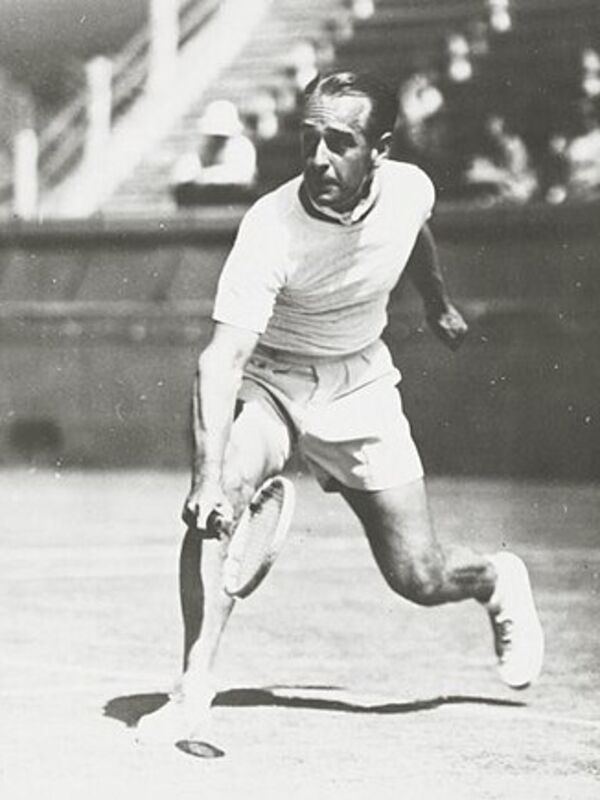
Born in Adelaide in 1913, Quist won the Australian junior singles in 1933 and joined the Davis Cup team the same year. He won the Australian singles in 1936, 1940 and 1948, and ten Australian doubles titles in a row between 1936 and 1950, the first two with Don Turnbull and the rest with John Bromwich. With Jack Crawford he won the French and Wimbledon doubles in 1935. In 1939 he reached No. 3 in the world, won the US doubles with Bromwich and helped Australia take the Davis Cup. He served as an army officer in the Second World War, spent most of his working life with Dunlop and later commentated on Davis Cup tennis for ABC radio. He entered the Hall of Fame in 1984 and died in Sydney in 1991.
1935 with Jack Crawford, beat Wilmer Allison and John Van Ryn 6-3, 5-7, 6-2, 5-7, 7-5. 1950 with John Bromwich, beat Geoff Brown and Bill Sidwell 7-5, 3-6, 6-3, 3-6, 6-2
Wimbledon singles
Best result a quarter-final in 1936
Australian doubles partners
Don Turnbull 1936 and 1937; John Bromwich eight in a row, 1938 to 1950. Finals lost 1933, 1934 and 1951
US doubles
Won 1939 with Bromwich, beat Jack Crawford and Harry Hopman 8-6, 6-1, 6-4. Final lost 1938 to Don Budge and Gene Mako
Finals to remember
Australian 1936: beat Jack Crawford 6-2, 6-3, 4-6, 3-6, 9-7. Australian 1948: beat Bromwich 6-4, 3-6, 6-3, 2-6, 6-3
Davis Cup on grass
Merion 1939: won the doubles with Bromwich and beat Bobby Riggs in five sets as Australia came back from 0-2 to beat the United States 3-2
Leading grass titles only: the grass majors, tour-level grass events since 1968 and the leading grass championships before 1968. † single source; ‡ sources disagree. Roll of champions
"I know of players of earlier years who would have sacrificed a couple of their fingers to have played for their country."
Anecdotes
The person behind the player.
Adelaide · 1920s
Advice from a cricketer
His father was a cricketer and sports-store owner, and the boy excelled at cricket at Pulteney Grammar School as well as captaining its tennis team. It was a visiting family friend, the English Test cricketer Patsy Hendren, who encouraged him to concentrate on tennis. He left school to work as an insurance clerk in 1928.
In the Inter-Zonal final against Germany he came within a point of beating Gottfried von Cramm 13 times, saving 12 match points of his own before losing 11-9 in the fifth set. Australia still won the tie, and a week later, in the Challenge Round against Great Britain on the Centre Court, Quist upset Bunny Austin.
The Challenge Round began as Germany invaded Poland, and the Australians learnt during the doubles that their country was at war. Sir Norman Brookes said of them: "Their duty here is to play tennis. They'll do it." Quist and Bromwich lost the first set to Jack Kramer and Joe Hunt, then won the next three.
Against Bobby Riggs, who had beaten him in the 1938 Challenge Round, Quist won the first set 6-1 and led 4-0 in the second. Riggs came back to two sets all. Quist led 5-1 in the fifth, saw Riggs save a match point in a 16-point game, and won it 6-4. Bromwich then beat Frank Parker to take the Cup.
He won the Wimbledon doubles with Jack Crawford in 1935 and again with John Bromwich in 1950. In between, he and Bromwich built a run of 38 straight wins in Australian doubles that ended only in 1951, when Frank Sedgman and Ken McGregor beat them in five sets.
He joined the board of Dunlop Sports in 1937, ran its sports goods division from 1963 to 1967 and helped introduce the Volley sandshoe to Australia, where it became a best-seller. He also commentated on Davis Cup matches for ABC radio, in what his biographer called a soft, confidential tone.