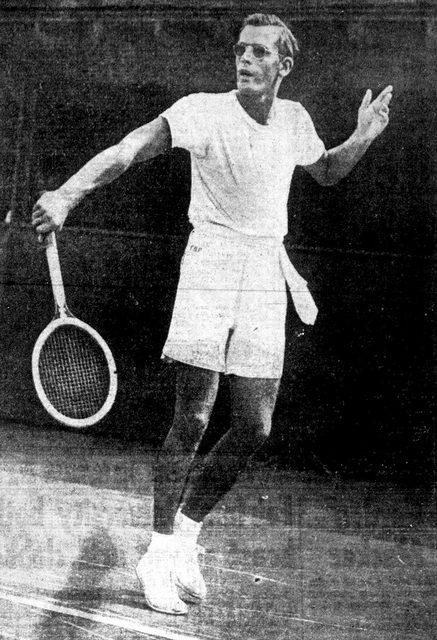
United States · born Milwaukee, Wisconsin, 1916 · died 1997 · right-handed · US champion 1944 and 1945, Wimbledon doubles champion 1949, 17 straight years in the US top ten
Frank Parker was born Franciszek Andrzej Pajkowski in Milwaukee on 31 January 1916, the youngest of five children of Polish immigrants. At ten he was found hitting old balls at the Milwaukee Town Club by the coach Mercer Beasley, who took charge of his game. He was national boys' champion at 15 and US clay court champion at 17, and in 1934, at 18, he won his first big grass titles, at South Orange and at the Meadow Club in Southampton. He won Southampton three years running and the Longwood Bowl in 1936.
In 1937 he reached the Wimbledon singles semi-finals and, on Centre Court, won the deciding rubber of the Davis Cup Challenge Round against Charles Hare, as the United States took the Cup from Great Britain. He lost the 1942 US final to Ted Schroeder in five sets, won the 1943 US doubles with Jack Kramer, and, as a sergeant in the US Army Air Forces, won the US singles at Forest Hills in 1944 and 1945, beating Bill Talbert both times. In 1947 he led Kramer by two sets in the final and lost.
He won the French title on clay in 1948 and 1949, and in 1949 won the Wimbledon doubles with Pancho Gonzales. In October 1949 he signed a one-year professional contract with Bobby Riggs, which ended his amateur career. He returned for the first US Open in 1968, aged 52, and lost in the first round to Arthur Ashe 6-3, 6-2, 6-2. He died in San Diego on 24 July 1997.
On grass
US Championships finals
1942: lost to Ted Schroeder 6-8, 5-7, 6-3, 6-4, 2-6. 1944: beat Bill Talbert 6-4, 3-6, 6-3, 6-3. 1945: beat Talbert 14-12, 6-1, 6-2. 1947: lost to Jack Kramer 6-4, 6-2, 1-6, 0-6, 3-6
Davis Cup 1937, Centre Court
Lost to Bunny Austin 3-6, 2-6, 5-7, then beat Charles Hare 6-2, 6-4, 6-2 in the deciding singles; the United States won the Challenge Round 4-1
Wimbledon
Singles semi-finalist 1937. Doubles champion 1949 with Pancho Gonzales, seeded three, beating the top seeds Gardnar Mulloy and Ted Schroeder 6-4, 6-4, 6-2
US doubles finals
1933 with Frank Shields: lost to George Lott and Lester Stoefen. 1943 with Jack Kramer: beat Bill Talbert and David Freeman 7-5, 8-6, 3-6, 6-1. 1948 with Schroeder: lost to Mulloy and Talbert 6-1, 7-9, 3-6, 6-3, 7-9
A long span
Played the US Championships for the first time in 1932 and for the last time at the 1968 US Open, 36 years later
Leading grass titles only: the grass majors, tour-level grass events since 1968 and the leading grass championships before 1968. † single source; ‡ sources disagree. Roll of champions
"Parker is a tough man to get past. Equipped with a wonderful all-court game, he plays intently and with classic form. His footwork is marvelous. You never see Frankie hitting the ball from an awkward position."
Anecdotes
The person behind the player.
Milwaukee, 1926
Old balls and a new name
He learnt the game hitting discarded balls at the Milwaukee Town Club, where Mercer Beasley spotted his quickness and accuracy. He took the name Parker because sports announcers could not pronounce Pajkowski.
As a teenager the press called him the Boy Wonder of Tennis. Once his strokes had settled into their groove, the journalists renamed him the Human Backboard.
At 17 he played a tournament match at Longwood in shorts. When older players followed his example, the club received complaints from members who found the exposed legs objectionable. His biographer Cynthia Beardsley also credits him as the first American to wear shorts in a Davis Cup match.
Jack Kramer wrote that as a boy Parker had a clean, hard forehand with slight overspin, until Beasley changed it into a chop: "It was obscene." Parker later worked to win back his old stroke, though Kramer thought it was never as good again.
He won both his US titles while serving as a sergeant in the US Army Air Forces, beating the civilian Bill Talbert in four sets in 1944 and in straight sets in 1945.
He rarely showed emotion and wore dark glasses on court, which earned him the nickname Mr. Incognito. Eddie Moylan said of him: "When you won a point from Frank, you deserved it."