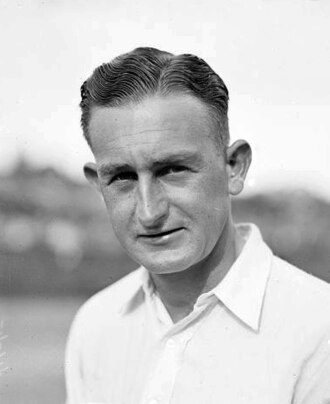
John Herbert Crawford was born on 22 March 1908 at Urangeline, near Albury in New South Wales, a farmer's son who played from 1926 to 1951. A baseliner who relied on accuracy rather than power, he won six major singles titles: four Australian Championships, Wimbledon in 1933 and the French in the same year, the first winner of that title from outside France. In 1933 he became the first man to win three majors in a season and was ranked world No. 1. He won 17 major titles in all, 11 of them in Australia, and played Davis Cup for Australia between 1928 and 1937. He entered the Australian Championships every year until 1951, was appointed OBE in 1977, was inducted into the International Tennis Hall of Fame in 1979, and died in Sydney on 10 September 1991.
On grass
Major singles titles
5: Wimbledon (1933); Australian (1931, 1932, 1933, 1935)
Major singles finals lost
5: Wimbledon 1934, Australian 1934, Australian 1936, Australian 1940, US 1933
5 doubles (Wimbledon 1, Australian 4), 4 mixed (Wimbledon 1, Australian 3)
Wimbledon finals
1933: beat Ellsworth Vines 4-6, 11-9, 6-2, 2-6, 6-4. 1934: lost to Fred Perry 3-6, 0-6, 5-7
US final 1933
Forest Hills, one match from the first Grand Slam: led Perry two sets to one and lost 3-6, 13-11, 6-4, 0-6, 1-6
Wimbledon doubles and mixed
Doubles 1935 with Adrian Quist, beating Wilmer Allison and John Van Ryn 6-3, 5-7, 6-2, 5-7, 7-5. Mixed 1930 with Elizabeth Ryan; mixed final lost 1928 with Daphne Akhurst
Australian doubles and mixed
Doubles 1929 and 1930 with Harry Hopman, 1932 with Edgar Moon, 1935 with Vivian McGrath. Mixed 1931, 1932 and 1933 with Marjorie Cox Crawford
Davis Cup
Australian team 1928, 1930 and 1932 to 1937; 23-16 in singles, 13-5 in doubles; finalist 1936
Leading grass titles only: the grass majors, tour-level grass events since 1968 and the leading grass championships before 1968. † single source; ‡ sources disagree. Roll of champions
"If Crawford wins, that would be something like scoring a grand slam on the courts, doubled and vulnerable."
Anecdotes
The person behind the player.
Australia · early career
Brookes's old racquet
After a friendly game, Norman Brookes gave him an old flat-topped racquet. Crawford liked the extra power it gave him when stretching for wide balls and kept it; the model came from the Alexander Patent Racket Company of Launceston, Tasmania. His endorsement helped start a late fashion for flat-tops in the 1930s.
Long stretches of the final against Ellsworth Vines were spent testing each other's backhands. After the last point of his five-set win, Crawford jumped the net to shake hands without thinking. "I didn't realize I could clear such a high barrier," he said afterwards.
On the cover of Time on 4 September, he led Fred Perry two sets to one in the US final. In the interval Crawford chatted with his wife and smoked while Perry changed and had a massage. An asthmatic, he took brandy and sugar for his breathing, perhaps too much that day. He won one more game.
Perry beat him for the Wimbledon title in straight sets, 6-3, 6-0, 7-5. Afterwards a club official consoled Crawford by telling him the better man had lost, with Perry close enough to hear it. It was the third major final Perry had won against him in under a year.
His first Wimbledon title came in the mixed with Elizabeth Ryan, who pushed him to come to the net more. They beat Hilde Sperling and Daniel Prenn 6-1, 6-3. His next three mixed titles, all at the Australian Championships, came with his wife, Marjorie Cox.
Known as Gentleman Jack, he kept to pressed white flannel trousers and a long-sleeved shirt while Bunny Austin made shorts fashionable. He was economical in his movement too: one writer said there had never been a champion "so indolently content to reach for wide shots or high lobs."