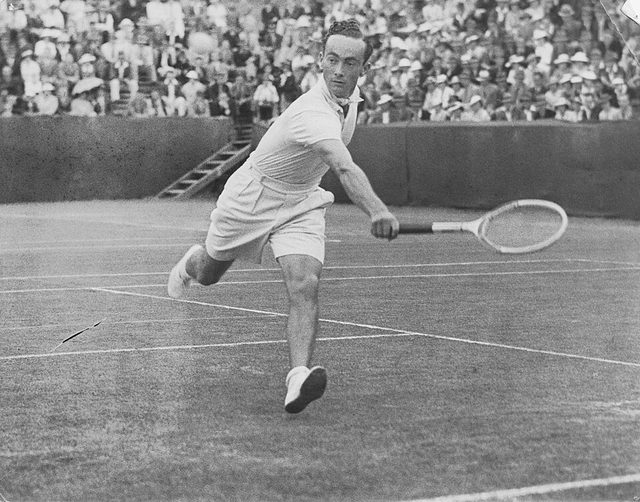
Australia · born Merrendee, New South Wales, 1916 · died 1978 · right-handed, two-handed backhand · Australian champion 1937 and an early master of the two-handed backhand
New South Wales doubles titles in a row with Jack Crawford, 1933 to 1937
4
Australian doubles finals with Crawford, 1935 to 1940
No. 8
World ranking in 1935 (A. Wallis Myers)
2
Wimbledon singles quarter-finals, 1935 and 1937
Playing career
Vivian Erzerum Bede McGrath was born on 17 February 1916 at Merrendee, near Mudgee in New South Wales, the fourth child of a hotelkeeper. He won the special singles at the New South Wales championships in 1931, the Australian junior singles in 1932 and the French junior singles in 1933. He hit his backhand with both hands, a stroke opponents took for a weakness, and made it his trademark. The press called him the Wonder Boy.
He was in the Australian Davis Cup squad from 1933 to 1937, without playing in a Challenge Round, and beat Fred Perry, Christian Boussus and Ellsworth Vines in his career. With Jack Crawford he won five New South Wales doubles titles in a row from 1933 to 1937 and the Australian doubles in 1935, beating Perry and Pat Hughes in the final. In January 1937, aged 20, he won the Australian singles at White City, Sydney, beating John Bromwich in five sets. He reached the Wimbledon quarter-finals in 1935 and 1937, and A. Wallis Myers ranked him eighth in the world in 1935.
He enlisted in the Australian Imperial Force in November 1941 and served in transport units, mainly in the Northern Territory, until his discharge as a sergeant in May 1946. He never recovered his earlier form. He worked for the sporting goods firm A. G. Spalding and Bros until the late 1950s, then coached in the Southern Highlands of New South Wales. He died at Burradoo on 9 April 1978, aged 62.
On grass
Australian singles final 1937
Beat John Bromwich 6-3, 1-6, 6-0, 2-6, 6-1 at White City, Sydney. Bromwich lost the final again in 1938, to Don Budge, and won the title in 1939
Australian doubles finals
All with Jack Crawford. 1935: beat Fred Perry and Pat Hughes 6-4, 8-6, 6-2 at Kooyong. 1936: lost to Adrian Quist and Don Turnbull 8-6, 2-6, 1-6, 6-3, 2-6. 1940: lost to Quist and Bromwich 3-6, 5-7, 1-6
Sydney, November 1932
Aged 16, took the first set 8-6 from Ellsworth Vines, the Wimbledon champion, before losing, and then beat Wilmer Allison, ranked second in the United States, in three sets, the last two 7-5, 6-3
Wimbledon
First visit 1933: lost to Harry Lee of Britain, to the surprise of his Davis Cup team-mates. Quarter-finalist in 1935 and 1937
Leading grass titles only: the grass majors, tour-level grass events since 1968 and the leading grass championships before 1968. † single source; ‡ sources disagree. Roll of champions
"being nervous would have meant that I had some hope of winning, and I hadn't any"
Anecdotes
The person behind the player.
Sydney, November 1932
No hope, no nerves
In November 1932, before thousands of spectators in Sydney, McGrath, aged 16, took a set from the touring American Ellsworth Vines and then beat Wilmer Allison. A correspondent reported that he was not nervous and gave McGrath's reason, "with a sagacity beyond his years".
Time magazine introduced him to American readers in July 1933 as the Australian "who holds his racket with both hands for backhands". It reported that he surprised his Davis Cup team-mates by losing at Wimbledon to Harry Lee of England.
He was nicknamed Wonderboy for what he did at so young an age. Because he was a strong attraction for crowds, he played a heavy schedule while still a boy, and Michael Sexton argues that it wore him out.
He enlisted in the Australian Imperial Force in November 1941 and served in transport units, mostly in the Northern Territory. During his service he played exhibition matches with visiting American servicemen. He was discharged as a sergeant in May 1946.
After leaving Spalding he coached at private schools in Bowral and Moss Vale, and travelled to Canberra each week to coach at the Japanese Embassy. Away from tennis he followed horse racing and the St George Dragons rugby league team.