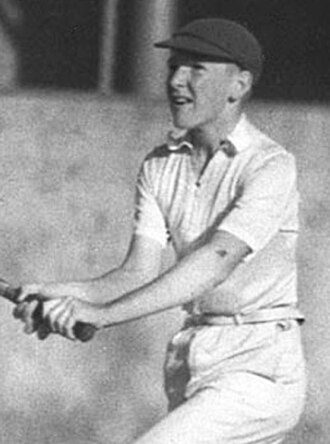
Born in Sydney in 1918, Bromwich learnt with an adult racquet too heavy to swing with one hand and kept a two-handed backhand all his life. At 18 he beat the top seed, Jack Crawford, in the 1937 Australian semi-finals, and he won the Australian title in 1939. That September he won the deciding rubber as Australia took the Davis Cup from the United States. He served in the Australian Army in New Guinea for much of the Second World War and lost about five years of play, then won the Australian Championships again in 1946 and reached the Wimbledon final in 1948. He won 13 major doubles titles, ten with Adrian Quist, and four in mixed, played Davis Cup until 1950 and entered the Hall of Fame in 1984. He died in Geelong in 1999.
On grass
Major singles titles
2: Australian (1939, 1946)
Major singles finals lost
6: Wimbledon 1948, Australian 1937, Australian 1938, Australian 1947, Australian 1948, Australian 1949
13 doubles (Wimbledon 2, Australian 8, US 3), 4 mixed (Wimbledon 2, Australian 1, US 1)
Wimbledon final 1948
Lost to Bob Falkenburg 7-5, 0-6, 6-2, 3-6, 7-5; he led 5-3 in the fifth set and held three match points
Wimbledon doubles and mixed
Doubles 1948 with Frank Sedgman, 1950 with Adrian Quist. Mixed 1947 and 1948 with Louise Brough, final lost in 1949
With Adrian Quist
Ten major doubles titles: eight Australian, 1938 to 1950; US 1939; Wimbledon 1950
US doubles and mixed
Doubles 1939 with Adrian Quist, 1949 with Bill Sidwell, 1950 with Frank Sedgman. Mixed 1947 with Louise Brough
Davis Cup 1939, Merion
On grass at the Merion Cricket Club, Pennsylvania: won the doubles with Quist, then beat Frank Parker 6-0, 6-3, 6-1 as Australia came back from 0-2 to win 3-2
Davis Cup record
39 wins and 12 losses for Australia between 1937 and 1950: 19-11 in singles, 20-1 in doubles
Leading grass titles only: the grass majors, tour-level grass events since 1968 and the leading grass championships before 1968. † single source; ‡ sources disagree. Roll of champions
"He could make the ball talk."
Anecdotes
The person behind the player.
Sydney · 1920s
Two hands on everything
Given an adult-sized racquet when he was too small to lift it with one hand, he used both. At first he hit two-handed on both sides and even served and smashed with two hands. He later dropped the two-handed forehand but kept the backhand, and became one of the first top players to win with it.
His racquet weighed under 12 ounces against the usual 14, with a grip almost as slim as a golf club's, and he strung it loose for control. "People called my racquet an onion bag," he said. The soft stringing had a side effect: "They complained they couldn't hear me hit the ball."
Australia lost both singles on the first day against the United States. Bromwich and Adrian Quist won the doubles, and in the deciding rubber Bromwich beat Frank Parker 6-0, 6-3, 6-1. The columnist John Kieran wrote: "At the end of the third set the Davis Cup left." Europe was going to war as they played.
A perfectionist, he berated himself for the smallest error and scratched at his chest through his shirt when things went wrong. Harry Hopman recalled him exclaiming: "I'll never win this if I keep making mistakes like that." Some took it for poor sportsmanship. Friends said he was so modest he would not give the scores of matches he had won.
At 5-3 in the fifth set against Bob Falkenburg he had match point and moved in to volley, then let the ball pass, sure it was going long. It landed on the baseline. Falkenburg saved two more match points and won the last four games. The next day Bromwich won the doubles with Frank Sedgman, and he took the mixed with Louise Brough.
He served with the Australian Army in New Guinea for much of the Second World War and missed about five years of tennis at his peak. He came back to win the Australian title in 1946, and after an attempt at retirement that did not last he beat both Tony Trabert and Lew Hoad in 1954.