Championship points saved in the 1948 Wimbledon final
22
His age when he won Wimbledon
71
Years until another man saved a championship point in a Wimbledon final and won, Novak Djokovic in 2019
18
His age when he won the 1944 US doubles title with Don McNeill
1,000+
Bob's restaurants in Brazil, the fast-food chain he founded
Playing career
Robert Falkenburg was born in New York on 29 January 1926 into a tennis family; his father was an engineer whose work took them to Brazil and Chile before they settled in Los Angeles in 1935. His brother Tom and sister Jinx both played the US Championships, and Jinx became a film actress. He entered the US top ten at 17, served in the Army Air Force during the war, won the US doubles in 1944 with Don McNeill at 18, and in 1946 won the NCAA singles and doubles for the University of Southern California.
In 1947 he won the Wimbledon doubles with Jack Kramer and the singles at Queen's. In 1948, seeded seventh, he beat Gardnar Mulloy in the semi-finals and John Bromwich in a five-set final, saving three championship points. He lost to Bromwich from two sets up in the 1949 quarter-finals.
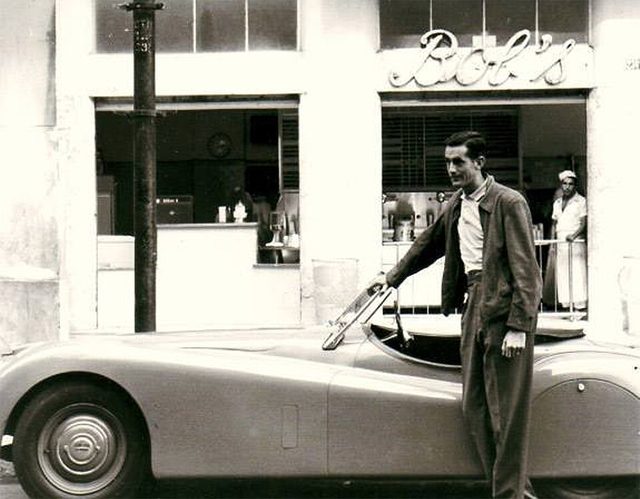
He married a Brazilian, Lourdes Mayrink Veiga Machado, in 1947, moved to Rio de Janeiro in 1950 and played Davis Cup for Brazil in 1954 and 1955. In Rio he opened an ice-cream shop near Copacabana in 1952, which grew into Bob's, the first fast-food chain in South America; he sold it in 1974. He won the Brazilian amateur golf title three times and was president of the Bel-Air Country Club. He entered the International Tennis Hall of Fame in 1974 and died at his home in Santa Ynez, California, on 6 January 2022, aged 95.
On grass
Wimbledon 1948 final
Beat John Bromwich 7-5, 0-6, 6-2, 3-6, 7-5. Bromwich served at 5-3, 40-15 in the fifth set; Falkenburg saved both points with backhand return winners, and on the third Bromwich came to the net and let Falkenburg's backhand return pass, thinking it would sail long. It landed in, and Falkenburg closed out the match with two aces
Wimbledon doubles 1947
With Jack Kramer, beat Tony Mottram and Bill Sidwell 8-6, 6-3, 6-3
US Championships doubles
1944: with Don McNeill, beat Pancho Segura and Bill Talbert 7-5, 6-4, 3-6, 6-1. 1945: with Jack Tuero, lost the final to Talbert and Gardnar Mulloy 12-10, 8-10, 12-10, 6-2
Wimbledon 1949
Lost the quarter-final to Bromwich 3-6, 9-11, 6-0, 6-0, 6-4 after winning the first two sets
Rare company
One of three men in a century to win the Wimbledon singles after facing championship point in the final, with Henri Cochet in 1927 and Novak Djokovic in 2019
Leading grass titles only: the grass majors, tour-level grass events since 1968 and the leading grass championships before 1968. † single source; ‡ sources disagree. Roll of champions
"I was lucky to win."
Anecdotes
The person behind the player.
Wimbledon 1948
I was tired
In the semi-final he knelt with his head on the grass and lay flat at the baseline to rest between points; the London press complained of his curious mannerisms, and he explained that he had been tired. In the final the crowd cheered his double faults. TIME reported that he gave away the second set 6-0 to save his strength, and The Daily Telegraph judged him more an overgrown schoolboy than a schemer.
In the dressing room after the final Bromwich said: "I had my chance, but I didn't take it." Tom Brown, the 1947 runner-up, described Falkenburg's approach: "He would review the situation, figure out what was likely, and take chances."
He met Lourdes Machado in Rio in December 1946. Walking with her on a hot day he wanted a chocolate milkshake, and they searched the city without finding one. Years later he opened a soft ice-cream shop near Copacabana beach, and queues formed around the block. "In those days, the concept didn't even exist here," he told a Brazilian journalist of the quick lunch.
His mother, Marguerite, was an accomplished player, and his sister Jinx, also a tournament player, was discovered by Samuel Goldwyn and became a model, film actress and talk-show host. His daughter Claudia said of her own childhood: "My claim to fame was that I was 'the owner of Bob's' daughter."
His daughter said he never wanted to turn professional and that she grew up seeing him play golf, not tennis. He won the Brazilian amateur golf championship three times and was known as a strong bridge, poker and chess player.