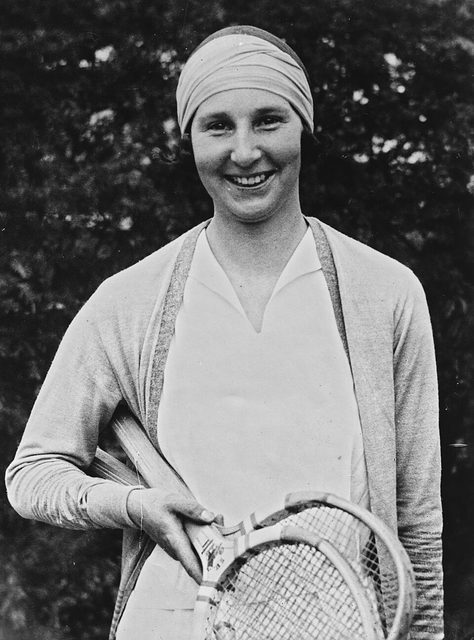
Dorothy Round grew up in Dudley, the youngest of four children of a building contractor, and learned the game against her brothers on the family's home court. She made her Wimbledon debut in the late 1920s, reached the quarter-finals in 1931 and lost the 1933 final to Helen Wills Moody. She won the title in 1934 and again in 1937, and took the mixed doubles three years running. On her only trip to Australia, in 1935, she became the first overseas player to win the women's singles. She played in the Wightman Cup from 1931 to 1936 and was ranked in the world top ten from 1933 to 1937. A Methodist, she would not play on Sundays. She later coached in Canada and the United States and was inducted into the International Tennis Hall of Fame in 1986.
Leading grass titles only: the grass majors, tour-level grass events since 1968 and the leading grass championships before 1968. † single source; ‡ sources disagree. Roll of champions
"I went into court with a tactical plan, but in the heat of the moment I am afraid I forgot all about it."
Anecdotes
The person behind the player.
Wightman Cup, New York
Not on a Sunday
A Methodist who taught at a Sunday school in Dudley through her years of fame, she would not play on Sundays and missed the 1933 French Championships for that reason. When a Wightman Cup match in New York was rained off into a Sunday, she waited for Monday. The New York Times noted that she did not play particularly well on Mondays.
In her first Wightman Cup singles she held seven match points against Anna Harper and converted none of them, losing in three sets. She later said the defeat persuaded her to play about 12 tournaments a season.
Against Helen Wills Moody she won the second set helped by a disputed line call. She asked the officials to overturn the point, but the decision stood. Back in the Black Country, people gathered round radios, newspapers sold out, and club members cheered "Good old Dorothy".
After her first Wimbledon title the town gave her a civic reception and named a hospital wing after her. Three years later, as champion again, she married at the Methodist church in Dudley; Ted Tinling designed the dress and the town hall reception had about 200 guests.
Against Hilde Sperling a shoulder strap broke. When she asked to leave the court to change, Sperling said she would rather carry on in case she got cold. Round finished the match with the strap held by a safety pin, and lost.
After the war she coached in Priory Park, Dudley. In 2013 a life-size bronze statue by John McKenna was unveiled there, beside the tennis courts, showing her about to return a serve while standing on a tennis ball. A bronze bust was installed at Wimbledon in 2004.