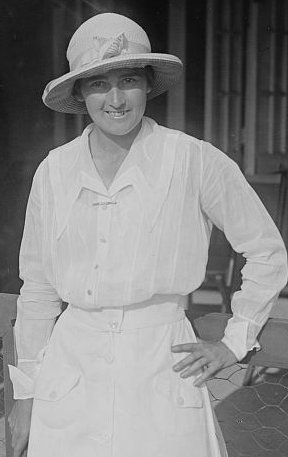
Mary Kendall Browne was born in Ventura County, California, in 1891 and learned the game from her brother Nat. Only five foot two, she won the US singles, doubles and mixed titles in 1912, and again in 1913 and 1914. She stopped playing in 1918 to work, returned in 1921 to win the doubles and mixed and reach the singles final, and played the Wightman Cup in 1925 and 1926. In 1926 she won the Wimbledon doubles with Elizabeth Ryan and became the first American woman to reach the French final. She then turned professional for C. C. Pyle's tour against Suzanne Lenglen. She was also runner-up in the 1924 US Women's Amateur at golf. Later she coached at Lake Erie College, and she entered the International Tennis Hall of Fame in 1957.
2: US (1913, 1914). Scored as a final won, not a full draw (-8 points).
US doubles partners
1912 with Dorothy Green; 1913, 1914 and 1921 with Louise Riddell Williams; 1925 with Helen Wills
US mixed partners
1912 with Richard Norris Williams; 1913 and 1914 with Bill Tilden; 1921 with Bill Johnston
Wimbledon 1926
Doubles champion with Elizabeth Ryan; mixed doubles final with Howard Kinsey
Finals to remember
1912: beat Eleonora Sears 6-4, 6-2. 1914: beat Marie Wagner 6-2, 1-6, 6-1 for a third title in a row. 1921: took the first set from Molla Mallory before losing in three
Leading grass titles only: the grass majors, tour-level grass events since 1968 and the leading grass championships before 1968. † single source; ‡ sources disagree. Roll of champions
"There is no woman in the world with a more comprehensive command of strokes and a fuller understanding of court technique."
Anecdotes
The person behind the player.
Philadelphia 1914
Keeping the cup
Her third straight title, a 6-2, 1-6, 6-1 win over Marie Wagner at the Philadelphia Cricket Club, meant she retired the Wissahickon Cup, the trophy then played for. In 1957, the year she was inducted, she gave the cup to the International Tennis Hall of Fame.
In February 1918 the Cornell Sun reported that she had given up tennis to become a bank teller in California, and quoted her saying she "will never compete in any championship tournament in the future." Three years later she won the US doubles and mixed titles again and reached the singles final.
In 1924 she reached the final of the national golf championship, beating Glenna Collett in the semi-final before losing to Dorothy Campbell Hurd. That made her the only person to play in the championship rounds of the national championships at both tennis and golf.
She was the first American woman to play the French final and lost 6-1, 6-0 to Suzanne Lenglen in heavy rain. "It is impossible to figure her out at all," Browne said. Lenglen called it her best match of the tournament, and during it asked the umpire to reverse calls in Browne's favour.
On C. C. Pyle's professional tour, which opened at Madison Square Garden, she met Lenglen again and again and never beat her. Pyle paid her extra for every game she won. In Portland she came within two points of 9-9 in the first set before losing it 11-9. The golf authorities then barred her from amateur competition.
She taught tennis part-time at Lake Erie College from 1930 to 1951, breaking off in the Second World War to serve with the American Red Cross in Australia and Italy. She was a self-taught artist, and her 1949 book Design for Tennis held that good strokes happen not by accident, but by design.