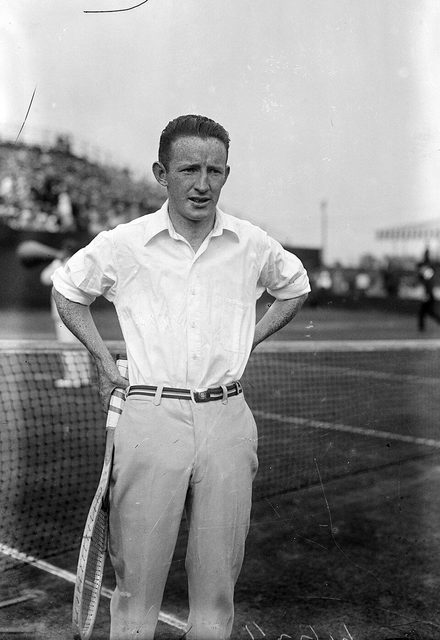
Born in San Francisco in 1894, Johnston learned the game on the public courts of Golden Gate Park and won his first tournament, the Bay Counties junior singles, in 1910. At 5ft 8in he was Little Bill to Bill Tilden's Big Bill. He won the US Championships in 1915 and 1919, beating Tilden in the 1919 final, and A. Wallis Myers ranked him world No. 1 that year. He served in the US Navy in the First World War, lost five US finals to Tilden between 1920 and 1925, and won Wimbledon in 1923. With Tilden he won seven Davis Cups in a row from 1920 to 1926. He turned down an offer to turn professional, retired after the 1927 season, later worked in the brokerage business and died in San Francisco in 1946.
On grass
Major singles titles
3: Wimbledon (1923); US (1915, 1919)
Major singles finals lost
6: US 1916, US 1920, US 1922, US 1923, US 1924, US 1925
Leading grass titles only: the grass majors, tour-level grass events since 1968 and the leading grass championships before 1968. † single source; ‡ sources disagree. Roll of champions
"The forehand drive of William M. Johnston is unquestionably the greatest single tennis shot in the world, bar none."
Anecdotes
The person behind the player.
San Francisco 1906
After the earthquake
He started playing in early 1906, at 11, on the public asphalt courts in Golden Gate Park. When the earthquake that spring closed the city's schools for months, he spent the time on court. The son of an electrical plant mechanic, he won his first tournament, the Bay Counties junior singles, in 1910.
Tilden walked out for the US final in a camel's hair coat with an armful of racquets; Johnston brought two. During the match a military plane carrying a photographer crashed about 200 feet from a grandstand, killing both men aboard. The umpire asked the players whether they could continue. Both said yes, and Tilden won in five sets.
In the Queen's final he beat Tilden 4-6, 6-2, 6-4, with the forehand again the difference, in what the Times correspondent called one of the finest matches ever seen in Great Britain. The two then teamed up and won the doubles title in about 30 minutes.
Both men had won two legs of the US challenge trophy, and a third would let the winner keep it. Johnston won the first two sets of the final and led 3-0 in the fourth, but Tilden took the last three sets, the fifth 6-4. For Johnston, who had hoped to win the trophy outright, it was a crushing disappointment.
With Tilden at home, Johnston went to Europe to show he was the world's second-best player. In Paris he won the World Hard Court Championships, beating René Lacoste in the semi-final, then took the Wimbledon title with the loss of a single set, crushing Frank Hunter in the final.
He weighed about 125 pounds and often lost five to eight pounds in a long match, yet galleries made him their favourite almost every time he went on court. The Times called him "the gamest man that ever trod on a court" in 1920. One of his trophies became the Olympic Club's perpetual singles trophy.