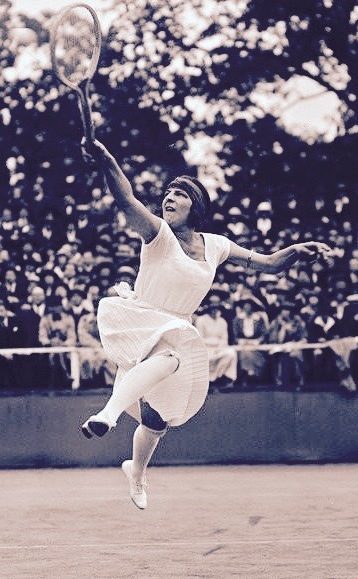
Born in Paris in 1899, Lenglen was coached from childhood by her father, Charles, who arranged for her to practise against men at the club in Nice. She won Wimbledon at her first attempt in 1919, aged 20, and took the singles six times by 1925. She also won the French Championships in 1925 and 1926, once they were open to foreign players, and two gold medals at the 1920 Olympics in Antwerp. After the war she lost one singles match, a retirement through illness against Molla Mallory at Forest Hills in 1921. The French press called her La Divine. In 1926 she signed with the promoter C. C. Pyle for a professional tour of the United States. She died in Paris in 1938, aged 39, and entered the International Tennis Hall of Fame in 1978.
On grass
Major singles titles
6: Wimbledon (1919, 1920, 1921, 1922, 1923, 1925)
Major doubles titles
6 doubles (Wimbledon 6), 3 mixed (Wimbledon 3)
Titles kept in a challenge round
2: Wimbledon (1920, 1921). Scored as a final won, not a full draw (-8 points).
Wimbledon finals
1919: beat Dorothea Lambert Chambers 10-8, 4-6, 9-7. 1920: beat Lambert Chambers 6-3, 6-0. 1921: beat Elizabeth Ryan 6-2, 6-0. 1922: beat Molla Mallory 6-2, 6-0. 1923: beat Kathleen McKane 6-2, 6-2. 1925: beat Joan Fry 6-2, 6-0
Wimbledon doubles
All six titles with Elizabeth Ryan: 1919, 1920, 1921, 1922, 1923 and 1925
Wimbledon mixed
1920 with Gerald Patterson, 1922 with Pat O'Hara Wood, 1925 with Jean Borotra
Missed years
Withdrew from the 1924 Championships with jaundice on her doctor's advice; withdrew from the singles in 1926 after the Queen Mary incident
Leading grass titles only: the grass majors, tour-level grass events since 1968 and the leading grass championships before 1968. † single source; ‡ sources disagree. Roll of champions
"She owned every kind of shot, plus a genius for knowing how and when to use them."
Anecdotes
The person behind the player.
Nice, 1910s
The masculine method
Charles Lenglen studied the best players at the club in Nice and asked why women should not adopt the methods of men. His daughter became the first woman to train regularly against men, in matches he arranged with visiting players. He drove her hard and was quick with criticism when she missed in practice.
In the challenge round against Dorothea Lambert Chambers, watched by King George V and Queen Mary, Lenglen kept going on cognac-soaked sugar lumps that her father tossed to her from the grandstand. She won 10-8, 4-6, 9-7. Lambert Chambers later said the match gave her opponent a taste of invincibility and a compulsion for it.
Her outfit for her first Wimbledon was a one-piece cotton dress that showed her forearms and stopped above the calf. Vogue praised its "freedom, the suitability, and the excellence of its simple lines." A strip of coloured silk wound round her bobbed hair became her trademark, and Jean Patou later designed her clothes.
Unwell with a heavy cold, she lost the first set 6-2 to Molla Mallory and then, after a double fault early in the second, told the umpire she could not continue. She was led sobbing from the court as some spectators booed. It was the only singles match she lost between 1919 and 1926.
Her one match with Helen Wills drew spectators who paid 50 francs a seat or watched from trees and ladders. With her father ill, her mother called from the stands that she was playing miserably. Lenglen shouted back "Merde, Maman!" and won in straight sets, saving a match point in the second.
A change to the order of play, which Lenglen said no one told her about, left Queen Mary looking at an empty court from the Royal Box for half an hour. The press turned on her and she withdrew from the singles. Months later she signed to play professionally, calling it "an escape from bondage and slavery."