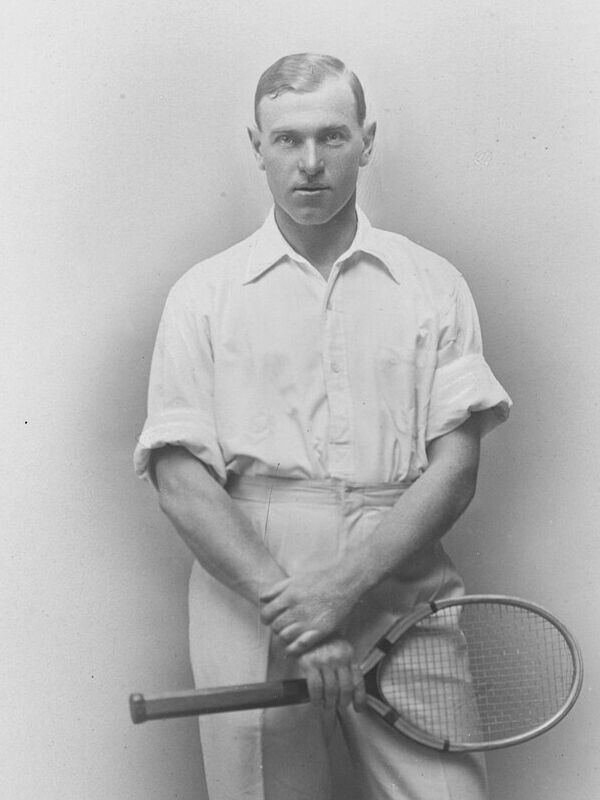
Born in Preston, Melbourne, on 17 December 1895, Patterson was a nephew of Dame Nellie Melba and was coached as a boy by Norman Brookes. At 19 he won the 1914 Australasian doubles and reached the singles final. War took him to the Royal Field Artillery and a Military Cross at Messines in 1917. In 1919 he beat Brookes for the Wimbledon title and was ranked world No. 1; he lost the crown to Bill Tilden in 1920, won it back in 1922, and took the Australian singles in 1927 after three lost finals. He played Davis Cup from 1919 to 1928 and captained the team in 1946. Off court he ran the Australian arm of A. G. Spalding and Bros, and he died in 1967. He entered the International Tennis Hall of Fame in 1989.
On grass
Major singles titles
3: Wimbledon (1919, 1922); Australian (1927)
Major singles finals lost
4: Wimbledon 1920, Australian 1914, Australian 1922, Australian 1925
6 doubles (Australian 5, US 1), 1 mixed (Wimbledon 1)
Finals to remember
1919 Challenge Round: beat Norman Brookes 6-3, 7-5, 6-2. 1922: beat Randolph Lycett 6-3, 6-4, 6-2 at the first Championships held at Church Road. 1927 Australian, Kooyong: beat Jack Hawkes 3-6, 6-4, 3-6, 18-16, 6-3
Losing the crown
1920 Challenge Round: lost to Bill Tilden 6-2, 3-6, 2-6, 4-6
Wimbledon mixed
1920 with Suzanne Lenglen, beating Elizabeth Ryan and Randolph Lycett 7-5, 6-3
Australian and US doubles
Australian titles in 1914 with Ashley Campbell, 1922, 1926 and 1927 with Jack Hawkes, and 1925 with Pat O'Hara Wood; US title in 1919 with Norman Brookes, beating Vincent Richards and Bill Tilden
Davis Cup on grass
In the Australasian team that kept the cup against the British Isles at Double Bay, Sydney, in January 1920
Leading grass titles only: the grass majors, tour-level grass events since 1968 and the leading grass championships before 1968. † single source; ‡ sources disagree. Roll of champions
"To be champion of the world at 23 is a feat indeed, and he merits a long and successful tennis career."
Anecdotes
The person behind the player.
Messines 1917
From the guns to Wimbledon
As an acting captain in the Royal Field Artillery he won the Military Cross for bravery at Messines in 1917. When the fighting stopped he played for the Australian Imperial Force team in England and Paris, and in the summer of 1919 he went on to win the first post-war Wimbledon.
Norman Brookes, a friend of his father, had coached him as a boy. In the 1919 Challenge Round the pupil beat the 41-year-old holder 6-3, 7-5, 6-2. The Argus in Melbourne noted with satisfaction that the championship was still held by an Australian, and the Brookes-Patterson pair then won the US doubles that year.
He lost his singles title to Bill Tilden in four sets in the 1920 Challenge Round, but the fortnight did not end empty-handed. With Suzanne Lenglen he won the mixed doubles, beating Elizabeth Ryan and Randolph Lycett 7-5, 6-3.
His aunt, the soprano Dame Nellie Melba, was his most devoted supporter, and she was on Centre Court in 1922 when he won the title for the second time. Late in life she called him her best friend, and he inherited part of her fortune.
The serve that earned him the name Human Catapult cut both ways in the 1927 Australian final against Jack Hawkes. He hit 29 aces and 29 double faults, trailed two sets to one, won the fourth set 18-16 and the fifth 6-3. It was the first Australian Championships at Kooyong.
In 1925 he tried a steel racquet strung with wire, years before metal frames caught on. That year his power had a cost for one opponent: in the Davis Cup tie against France a smash struck Jean Borotra and knocked him unconscious.