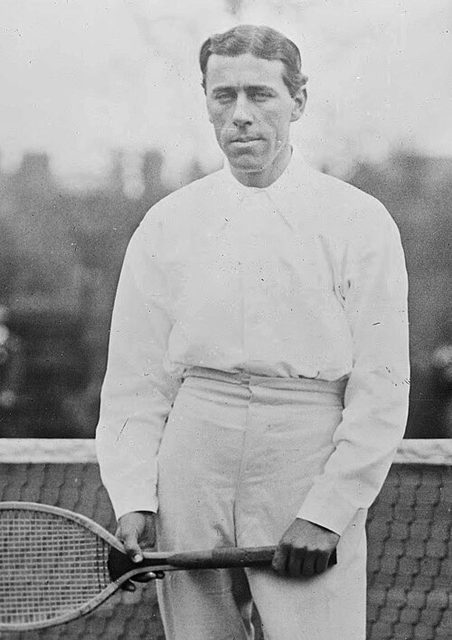
First overseas and first left-handed Wimbledon champion
28-11
Davis Cup match record
46
Age at his 1924 Australasian doubles title
29
Years as Australian tennis president, 1926 to 1955
Playing career
Norman Brookes was born in St Kilda, Melbourne, in 1877, the youngest son of William Brookes, who made his fortune in gold mining near Bendigo. He was educated at Melbourne Grammar and joined Australian Paper Mills, where he was on the board within eight years. He won the All-Comers at Wimbledon in 1905, the title in 1907 and again in 1914, and the Australasian Championships in 1911. He played Davis Cup from 1905 to 1920 and helped Australasia to five titles. During the First World War he served as a British Red Cross commissioner in Egypt and Mesopotamia. He won his last major title, the 1924 Australasian doubles, at 46, was president of the Lawn Tennis Association of Australia from 1926 to 1955 and was knighted in 1939. He died in Melbourne in 1968.
On grass
Major singles titles
3: Wimbledon (1907, 1914); Australian (1911)
Major singles finals lost
2: Wimbledon 1905, Wimbledon 1919
Other grass singles titles
8: Victorian Championships 4 (1902, 1903, 1904, 1906); Eastbourne (1905); Kent (1905); Northern Championships (1907); SA Championships (1906)
Major doubles titles
4 doubles (Wimbledon 2, Australian 1, US 1)
Wimbledon doubles
1907 with Anthony Wilding, beat Karl Behr and Beals Wright 6-4, 6-4, 6-2. 1914 with Wilding, beat Herbert Roper Barrett and Charles Dixon 6-1, 6-1, 5-7, 8-6
Wimbledon singles finals
1905 Challenge Round: lost to Laurence Doherty 8-6, 6-2, 6-4. 1907: beat Arthur Gore 6-4, 6-2, 6-2. 1914 Challenge Round: beat Anthony Wilding 6-4, 6-4, 7-5. 1919 Challenge Round: lost to Gerald Patterson 6-3, 7-5, 6-2
Other doubles majors
US 1919 with Gerald Patterson, beat Bill Tilden and Vincent Richards in five sets. Australasian 1924 with James Anderson
Australasian singles
1911: beat Horace Rice 6-1, 6-2, 6-3 without losing a set in the event
Davis Cup
Five titles with Australasia. Record 28-11. In 1914 he and Wilding took the Cup from the United States in New York days after war broke out
Leading grass titles only: the grass majors, tour-level grass events since 1968 and the leading grass championships before 1968. † single source; ‡ sources disagree. Roll of champions
"In his younger days he had a strong temper, almost an obsession to have his own way."
Anecdotes
The person behind the player.
London, 1905
Standing room only
He paid his own way to his first Wimbledon. He later recalled that a railway clerk at first refused to sell him a ticket, and that he had to stand on the train with his bag and two racquets and then walk to the courts. He won the All-Comers and lost the Challenge Round to Laurence Doherty.
He played in long sleeves and a peaked tweed cap, and he did not remove it. The Argus reported: "Not once did he ever take his hat off; here was pure determination." When serving he let out what the paper likened to an axeman's grunt, an "explosive pant".
After he and Wilding won the Davis Cup, Brookes brought the trophy home to Australia in his luggage at his own expense of £7 10s. His wife Mabel recalled that it stood on their sideboard for years, and that she once filled it with red peonies.
In the Challenge Round he faced Anthony Wilding, his doubles partner and the holder for four years, and won 6-4, 6-4, 7-5. The two then took the doubles together. Weeks later, after war had broken out, they won the Davis Cup in New York; within a year Wilding had been killed in France.
Turned down for active service, he became commissioner for the Australian branch of the British Red Cross in Egypt from August 1915, then served the British Red Cross in Mesopotamia with the rank of lieutenant-colonel. Later in life he took up golf and won the Australian foursomes championship twice.
As president he was called the czar of Australian tennis and was charged with being autocratic. When Jack Kramer courted Lew Hoad he said: "I thought it wouldn't be long before Kramer would be butting in." When Hoad turned professional he called it "a poor sort of a show".