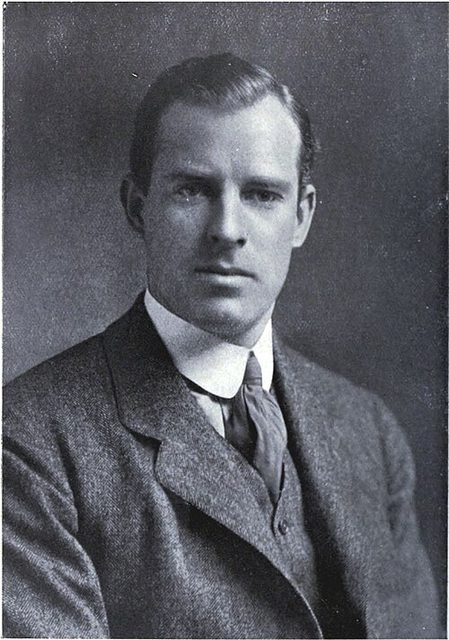
Anthony Wilding was born in Christchurch in 1883, the son of a lawyer, and was given his first racquet at six. He sailed for England in 1902 to read law at Trinity College, Cambridge, and was called to the English Bar in 1906. That year he won the first of two Australasian singles titles and a record 23 tournaments. He won Wimbledon four times running from 1910 to 1913, and in 1913 also took the world titles on clay in Paris and on wood in Stockholm. He won four Davis Cups for Australasia, the last with Norman Brookes in 1914, and he took a bronze medal indoors at the 1912 Olympics. He joined the Royal Marines when war broke out and was killed at Aubers Ridge, France, on 9 May 1915, aged 31.
On grass
Major singles titles
6: Wimbledon (1910, 1911, 1912, 1913); Australian (1906, 1909)
Major singles finals lost
1: Wimbledon 1914
Other grass singles titles
15: Queen's 4 (1907, 1910, 1911, 1912); Kent Championships 3 (1907, 1911, 1912); New Zealand Championships 3 (1906, 1908, 1909); South of England Championships 2 (1906, 1908); Victorian Championships 2 (1908, 1909); Scottish Championships (1904)
Major doubles titles
5 doubles (Wimbledon 4, Australian 1)
Titles kept in a challenge round
3: Wimbledon (1911, 1912, 1913). Scored as a final won, not a full draw (-12 points).
Wimbledon doubles
1907 and 1914 with Norman Brookes; 1908 and 1910 with Major Ritchie
Wimbledon Challenge Rounds
1910: beat Arthur Gore 6-4, 7-5, 4-6, 6-2. 1911: beat Herbert Roper Barrett 6-4, 4-6, 2-6, 6-2, retired. 1912: beat Gore 6-4, 6-4, 4-6, 6-4. 1913: beat Maurice McLoughlin 8-6, 6-3, 10-8. 1914: lost to Norman Brookes 6-4, 6-4, 7-5
Wimbledon mixed
Final 1914 with Marguerite Broquedis, lost to James Cecil Parke and Ethel Larcombe 4-6, 6-4, 6-2
Australasian doubles
1906 with Rodney Heath
Davis Cup
Four titles with Australasia: 1907, 1908, 1909, 1914, the last won with Brookes on grass at Forest Hills. Record 21-9 (15-6 singles, 6-3 doubles)
Leading grass titles only: the grass majors, tour-level grass events since 1968 and the leading grass championships before 1968. † single source; ‡ sources disagree. Roll of champions
"To my great delight I captured a set and made Mahony talk to himself a great deal"
Anecdotes
The person behind the player.
Christchurch, 1889 to 1902
A racquet at six
He started playing in 1889, aged six, with a racquet from Ralph Slazenger. His father, a lawyer, had won New Zealand doubles titles. He failed his matriculation once, passed in 1901, won the Canterbury Championships at 17 and in July 1902 sailed for England, where he became honorary secretary of the Cambridge University Lawn Tennis Club.
He often rode a motorcycle between tournaments in Europe. In July 1908 he won a gold medal in a 1,437 km reliability trial from Land's End to John o' Groats on a BAT-JAP machine. In 1910 he rode from London to Lake Geneva and back, covering the 560 km from Évian-les-Bains to Paris in a single day.
He believed tennis alone was not enough: "play must be combined with various other exercises. The prizefighter does not limit his training to sparring." His rule for living was plainer still: "Be moderate in all things, especially in eating, smoking and drinking."
Norman Brookes, his doubles partner and rival, called him "one of the finest specimens of manhood". His great-niece Anna Wilding said he was "like a movie star, but on the tennis court". When war came in 1914 he was expected to marry the Broadway actress Maxine Elliott.
He answered the Admiralty's call for gentlemen motorists and wrote home in October 1914: "I go out about 5.30 a.m. and motor as near to the German lines and outposts as possible." An infantry officer recalled him arriving at the front in slacks, having not troubled with the regulation breeches and puttees.
On the eve of the battle a fellow officer teased him: "Well, old man, you were in rotten form when you met Brookes," a reference to the 1914 Wimbledon final. Wilding answered: "One can't always be at one's best." The next afternoon a shell struck the roof of his dugout and he was killed, aged 31.