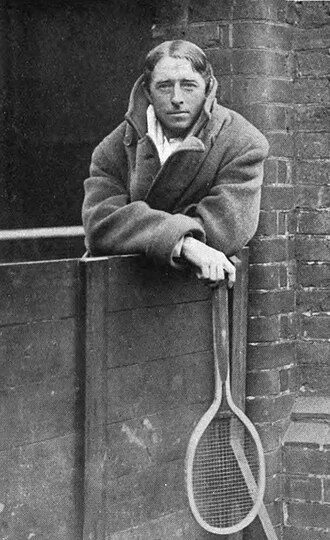
Wimbledon doubles titles with Tony Wilding, 1908 and 1910
4
Wimbledon All Comers singles finals: 1902, 1903, 1904 and 1909
62
Wimbledon singles matches won, 1897 to 1926
Playing career
Josiah George Ritchie, whose first given name was Major, was born in Westminster in 1870 and learned the game on the family court at Putney. At Brighton College he was known as a fine gymnast rather than a tennis player, and he only took up the game seriously in 1892, aged 21. He won the French covered court title in 1899 and went on to a long record at home and abroad, including five German championships at Hamburg and a straight-sets win over Laurence Doherty in the Monte Carlo final of 1907.
On grass he reached the Wimbledon All Comers final three years running from 1902 to 1904 and won it in 1909, when he led Arthur Gore by two sets to love in the Challenge Round before losing in five. At the 1908 Olympic Games, played at Wimbledon, he won the singles gold against Otto Froitzheim and a silver in the doubles with James Cecil Parke, having already won bronze in the covered court singles at Queen's Club. With Tony Wilding he won the Wimbledon doubles in 1908 and 1910 and lost the 1911 Challenge Round.
He played the Wimbledon singles from 1897 to 1926 and won 62 matches. In 1919, aged 48, he reached the All Comers semi-final and was the only man in the event to take a set from Gerald Patterson; Wallis Myers wrote that he was nearly as good at fifty as he had ever been. He also rowed, wrote a book on table tennis in 1902 and The Text Book of Lawn Tennis in 1909. His son Richard was secretary of Queen's Club for some 30 years. Ritchie died at Ashford, Middlesex, in 1955.
On grass
Wimbledon singles
All Comers finals: 1902 lost to Laurence Doherty 8-6, 6-3, 7-5; 1903 lost to Frank Riseley 1-6, 6-3, 8-6, 13-11; 1904 lost to Riseley 6-0, 6-1, 6-2; 1909 beat Herbert Roper Barrett 6-2, 6-3, 4-6, 6-4. 1909 Challenge Round: lost to Arthur Gore 6-8, 1-6, 6-2, 6-2, 6-2
Wimbledon doubles
With Wilding: 1908 champions after beating Roper Barrett and Gore 6-1, 6-2, 1-6, 9-7 in the All Comers final, the holders not defending; 1910 Challenge Round beat Gore and Barrett 6-1, 6-1, 6-2, 22 games, the fewest in any best-of-five men's doubles final at Wimbledon; 1911 Challenge Round lost to Max Decugis and André Gobert 9-7, 5-7, 6-3, 2-6, 6-2
Olympic Games 1908, Worple Road
Singles final: beat Otto Froitzheim 7-5, 6-3, 6-4. Doubles final with James Cecil Parke: lost to George Hillyard and Reginald Doherty 9-7, 7-5, 9-7
Longevity
86 Wimbledon singles matches across 30 years, 62 won and 24 lost. In 1923, aged 52, he was runner-up in the All England Plate, losing to Jean Washer 6-3, 6-4
Leading grass titles only: the grass majors, tour-level grass events since 1968 and the leading grass championships before 1968. † single source; ‡ sources disagree. Roll of champions
"No man living has played more lawn tennis than this hard-grained expert of the British school."
Anecdotes
The person behind the player.
Laleham and Wimbledon, 1909
The starting handle
Myers stayed the night before the 1909 Challenge Round on Ritchie's houseboat at Laleham-on-Thames. Driving to Wimbledon the car broke down and Ritchie had to crank the engine hard with his right arm. That afternoon Gore, sponging his face at the umpire's chair every other game, recovered from two sets and 2-0 down to win in five. Myers later wondered whether the incident had played a part.
Myers recorded a youth at the Championships asking his companion whether he knew any of the leading players. "Well, not exactly," came the reply, "but Ritchie asked me the time yesterday as he was stepping into his motor."
In the Olympic final the 22-year-old Otto Froitzheim decided to take on Ritchie, 15 years his senior, from the baseline. Ritchie had few peers at that kind of game, and won in straight sets.
Ritchie beat Laurence Doherty, unbeaten at Wimbledon in singles during his reign as champion, in the Monte Carlo final 8-6, 7-5, 8-6. Myers wrote that it caused quite a flutter in the lawn tennis dovecots of Europe and America, and that it was no fluke: Ritchie had beaten Doherty under cover at Queen's in 1904, attacking at the net.
After winning his third German championship in 1905 Ritchie became the owner of the trophy, as was the custom. The cup was probably lost when his house was bombed in the Second World War.
At school he did not specialise in tennis but played many sports and was best known as a particularly fine gymnast. He did not take lawn tennis seriously until early in 1892, when he was 21.