Suffolk Championships singles titles at Saxmundham, 1898 to 1921
1900
Played in the first Davis Cup tie, at Boston
Playing career
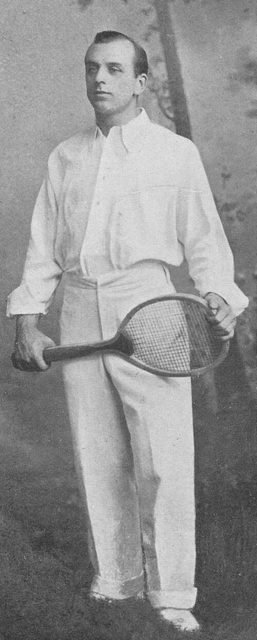
Herbert Roper Barrett was born at Upton, Essex, in 1873 and learned the game at Merchant Taylors' School and the Forest Gate club. A solicitor by profession, he still found time for a long tournament season and won a great many events: the Belgian title four years running from 1900, the Austrian title in 1904, and the Suffolk Championships on the grass at Saxmundham 17 times between 1898 and 1921.
He first played the Wimbledon singles in 1898. He lost the All Comers final in 1908 and 1909, won it in 1911 by beating Charles Dixon from two sets down, and then retired against Tony Wilding at two sets all in the Challenge Round. In doubles he won Wimbledon with Arthur Gore in 1909 and with Dixon in 1912 and 1913. With Gore he also won the Olympic covered court doubles at Queen's Club in 1908, and at Stockholm in 1912 he took silver in the indoor mixed with Helen Aitchison.
He played for Britain in the first Davis Cup tie, at Boston in 1900, and last played in the competition in 1919. As non-playing captain in the 1930s he led Britain to four Davis Cup wins in a row. He was chairman of the Lawn Tennis Association and Chief Commoner of the City of London in 1924, twice Master of the Worshipful Company of Farriers, and a footballer for Corinthian Casuals. He was still playing Wimbledon doubles with Gore in 1926. He died at Horsham, Sussex, in 1943.
On grass
Wimbledon singles
All Comers finals: 1908 lost to Arthur Gore 6-3, 6-2, 4-6, 3-6, 6-4; 1909 lost to Major Ritchie 6-2, 6-3, 4-6, 6-4; 1911 beat Charles Dixon 5-7, 4-6, 6-4, 6-3, 6-1. 1911 Challenge Round: lost to Tony Wilding 6-4, 4-6, 2-6, 6-2, retired
Wimbledon doubles titles
1909 with Gore: the holders did not defend, and the All Comers final was won 6-2, 6-1, 6-4 over Stanley Doust and Harry Parker. 1912 with Dixon: beat Max Decugis and André Gobert 3-6, 6-3, 6-4, 7-5. 1913 with Dixon: beat Heinrich Kleinschroth and Friedrich Rahe 6-2, 6-4, 4-6, 6-2
Doubles finals lost
Challenge Rounds: 1900 with Harold Nisbet to the Doherty brothers 9-7, 7-5, 4-6, 3-6, 6-3; 1910 with Gore to Ritchie and Wilding 6-1, 6-1, 6-2, the fewest games in any best-of-five men's doubles final at Wimbledon; 1914 with Dixon to Norman Brookes and Wilding 6-1, 6-1, 5-7, 8-6. All Comers finals lost in 1899, 1901 and 1908
Mixed doubles (non-championship event)
Won in 1909 with Agatha Morton, beating A.D. Prebble and Dora Boothby 6-2, 7-5; runner-up in 1900 and 1908
Triple bagel
In the second round in 1899 he beat C.G. Allen 6-0, 6-0, 6-0, one of 16 such results in the Wimbledon men's singles
Leading grass titles only: the grass majors, tour-level grass events since 1968 and the leading grass championships before 1968. † single source; ‡ sources disagree. Roll of champions
"He was, and remains, a prince of tacticians, ever ready to decoy the unsuspecting into a death-trap"
Anecdotes
The person behind the player.
Saxmundham
The telegram
At the Suffolk tournament the Allen twins, E.R. and C.G., were hoping for an easier week at Bournemouth. A telegraph boy brought Barrett a message, which he read aloud: "Will you partner me Bournemouth? Smith." Charlie Allen shouted to his brother: "Roy! Did you hear? S. H. Smith is going to Bournemouth. Just like our luck!" The joke ran for some hours before someone told the twins that Barrett had sent the telegram himself.
In the Davis Cup Challenge Round doubles, Norman Brookes and Wilding won the first two sets against Gore and Barrett, and Brookes served at 5-4 in the third with one stroke needed to take the Cup. The British pair turned the match round and, an hour and twenty minutes later, won the final set 13-11.
The Challenge Round against Wilding was played with the Centre Court "resembling a baker's oven". Barrett drew Wilding in with drop shots and lobbed him when he arrived; Myers called it "a kind of bumble-puppy" and left the stands to find a breeze. Barrett, completely exhausted, retired at two sets all.
At the Jubilee Championships in 1926, Prince Albert, later King George VI, played the men's doubles with Louis Greig. They were well beaten in the first round by Roper Barrett, then 52, and Arthur Gore, 58.
Barrett was a solicitor, as was his partner Dixon. He was twice Master of the Worshipful Company of Farriers, Chief Commoner of the City of London in 1924, the year he also chaired the Lawn Tennis Association, and a regular footballer for Corinthian Casuals at Weybridge.