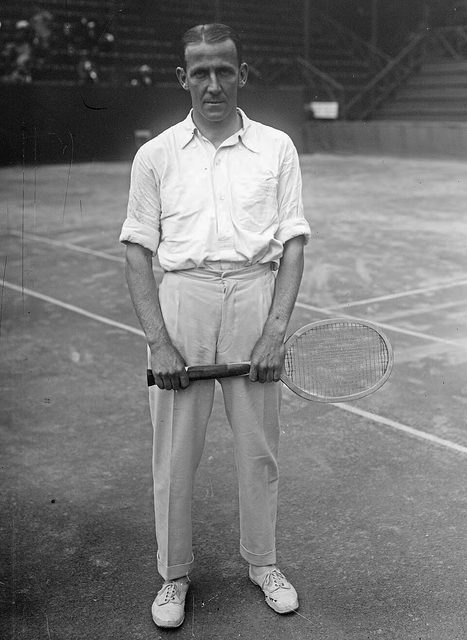
Born in St Kilda, Melbourne, in 1891, the son of a barrister, Hector "Pat" O'Hara Wood learned tennis with his elder brother Arthur from their father. He studied law at the University of Melbourne and in 1915 enlisted in the 13th Light Horse, serving at Gallipoli and in France and ending the war as a captain. He won the Australasian singles in 1920 and 1923 and four Australasian doubles titles, and played Davis Cup in 1920, 1922 and 1924. In 1926 he published The World's Tennis Stars and How to Play the Game. He turned professional in 1930, coached for the Lawn Tennis associations of Australia and Victoria and ran a sports store in Collins Street, Melbourne. He died in Richmond, Melbourne, in 1961.
Leading grass titles only: the grass majors, tour-level grass events since 1968 and the leading grass championships before 1968. † single source; ‡ sources disagree. Roll of champions
"There is little doubt that O'Hara Wood considerably helped to establish the character of Australian tennis."
Anecdotes
The person behind the player.
Paris 1919
Captain and bombardier
At the Inter-Allied Games in Paris in 1919, Captain Pat O'Hara-Wood won the doubles with Bombardier Randolph Lycett. Three years later Lycett was across the net in the Wimbledon mixed final, and O'Hara Wood and Suzanne Lenglen beat him and Elizabeth Ryan 6-4, 6-3.
A law student when war came, he enlisted in the 13th Light Horse in January 1915, served at Gallipoli and later in France as aide-de-camp to Major General Nevill Smyth and General Sir William Birdwood. He was mentioned in dispatches in May 1918 and promoted captain that July.
His elder brother Arthur, taught the game alongside him by their father, won the Australasian singles in 1914. He joined the Royal Air Force and was shot down over St Quentin in October 1918, weeks before the armistice. Pat won the same title in 1920 and again in 1923.
Tennis was not his only game. He excelled at cricket at Melbourne Grammar, and in March 1911, soon after entering Trinity College at the University of Melbourne, he scored 167 not out for Trinity against Ormond College. Four years later he was a Light Horse officer on his way to Gallipoli.
On 3 August 1923, the year of his second Australasian singles title, he married Meryl Lister, née Waxman, at All Saints' Church, St Kilda. She was a prominent player in her own right and won the Australian women's doubles in 1926 and 1927.
His six Australian titles earned him no prize money: as an amateur he played, as he put it, for the love of the game. Frustrated by that, he turned professional in 1930 and became official coach to the Lawn Tennis associations of Australia and Victoria and to the South Yarra Tennis Club.