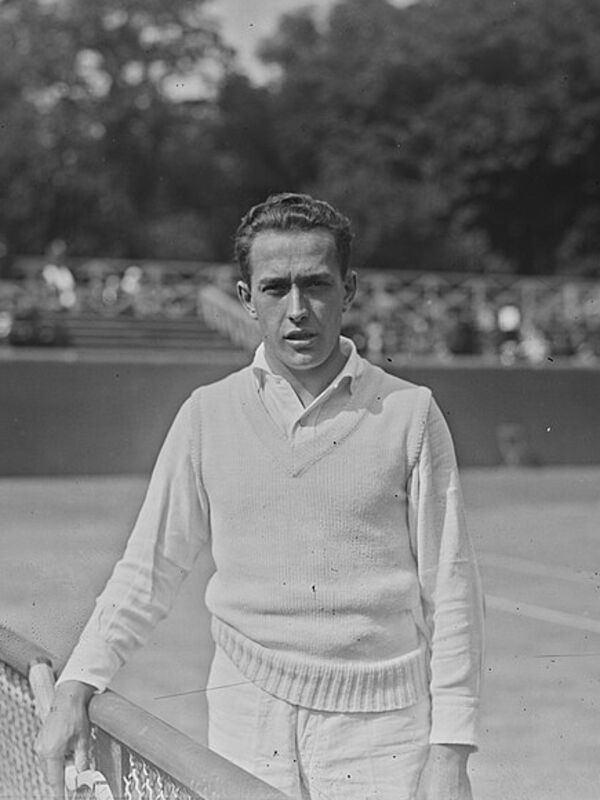
Born in Villeurbanne, beside Lyon, in 1901, Cochet won seven major singles titles: the French Championships in 1926, 1928, 1930 and 1932, Wimbledon in 1927 and 1929, and the US Championships in 1928. He added five major doubles titles, all with Jacques Brugnon, and three in mixed doubles. A. Wallis Myers ranked him world No. 1 for four years running, 1928 to 1931, and he played in all six French Davis Cup wins from 1927 to 1932. In September 1933 he turned professional, joining Bill Tilden's tour for a guaranteed £25,000 a year, and won the French Pro Championship in 1936. Reinstated as an amateur during the war, he played on into his late forties, then ran a sporting goods shop in Paris and taught tennis into his seventies. He died in 1987.
On grass
Major singles titles
3: Wimbledon (1927, 1929); US (1928)
Major singles finals lost
2: Wimbledon 1928, US 1932
Major doubles titles
2 doubles (Wimbledon 2), 1 mixed (US 1)
Wimbledon finals
1927: beat Jean Borotra 4-6, 4-6, 6-3, 6-4, 7-5, saving six match points. 1929: beat Borotra 6-4, 6-3, 6-4
Wimbledon 1927 route
Came from two sets down to beat Frank Hunter in the quarter-final, Bill Tilden in the semi-final and Borotra in the final
Wimbledon doubles
Champion 1926 and 1928 with Jacques Brugnon; finalist 1927 and 1931 with Brugnon. 1928 final: beat John Hawkes and Gerald Patterson 13-11, 6-4, 6-4
US mixed doubles
1927 with Eileen Bennett
Davis Cup on grass
1927 Challenge Round, Germantown Cricket Club, Philadelphia: lost to Bill Tilden, then beat Bill Johnston 6-4, 4-6, 6-2, 6-4 in the deciding fifth rubber; France won 3-2
Leading grass titles only: the grass majors, tour-level grass events since 1968 and the leading grass championships before 1968. † single source; ‡ sources disagree. Roll of champions
"Henri Cochet can beat everybody when his shots are working and be beaten by everybody when they are not."
Anecdotes
The person behind the player.
Lyon, childhood
The ball boy
His father was groundskeeper, and later manager, at a Lyon tennis club. Henri earned pocket money chasing stray balls and hit with anyone who would lend him a racket. The club's covered courts had wooden floors, and playing on them all year taught him to meet the ball on the rise and to half-volley without fear.
At the US Championships he beat Bill Tilden, who had won the American title every year since 1920, ending a six-year winning streak at Forest Hills. The American press called the day Black Thursday. A year later he beat Tilden again, from much further behind, in the Wimbledon semi-final.
Tilden won the first two sets 6-2, 6-4 and led 5-1 in the third. From 15-all Cochet won 17 points in a row, took the set 7-5 and the match 6-3, 6-4. The referee, F. R. Burrow, wrote that the crowd was almost too spellbound to applaud.
In the year he became world No. 1 he arrived ten minutes late for the final of the Cannes Championships and was defaulted. The newspapers called him Five-Set Cochet, the New Yorker profiled him as Lucky Cochet, and John Tunis wrote of an enfant terrible who loved to play with fire.
As a professional he played exhibitions around the world, coached the Hungarian Davis Cup team and taught young players in the Soviet Union. In 1938 his Soviet hosts accused him of espionage and expelled him, during a purge of foreign influence.
His last title came at the Barcelona International Christmas tournament, where he beat Jack Harper at the age of 48. The same year he played his last competitive match, against his old teammate Jean Borotra, and lost in three sets. He kept teaching tennis into his seventies.