Her age in the 1927 US final, then the youngest finalist
36 min
Length of her 1930 US final win over Anna McCune Harper
38
Years before another British woman won the US title
5
US doubles and mixed titles, 1929 to 1933
27-13
Wimbledon singles record in 14 Championships, 1926 to 1946
Playing career
Betty Nuthall was born in Surbiton in 1911 and taught by her father, Stuart, a keen tournament player. She won the British junior title three years running from 1924 and played her first Wimbledon in 1926, at 15. A year later, aged 16 and still serving underarm, she reached the US final at Forest Hills and lost to Helen Wills 6-1, 6-4.
In 1930, now serving overarm, she beat Anna McCune Harper 6-1, 6-4 in 36 minutes to become the first British woman to win the US singles. She won the US women's doubles in 1930, 1931 and 1933 and the mixed in 1929 and 1931 with George Lott. In Paris she reached the 1931 singles final, lost to Cilly Aussem, and won the doubles that year and the mixed in 1931 and 1932. She reached a world ranking of No. 4 in 1929 and played the Wightman Cup for Britain, winning it in 1928.
Wimbledon was her one gap: in 14 Championships she never went past the quarter-finals. She stayed in the United States during the Second World War, married Franklin Shoemaker in 1954 and died in New York in 1983. She entered the Hall of Fame in 1977.
On grass
US singles finals
1927: lost to Helen Wills 6-1, 6-4, aged 16. 1930: beat Anna McCune Harper 6-1, 6-4, with Wills absent and Helen Jacobs injured
US women's doubles
1930 with Sarah Palfrey, beat Edith Cross and Harper 3-6, 6-3, 7-5. 1931 with Eileen Bennett Whittingstall, beat Helen Jacobs and Dorothy Round 6-2, 6-4. 1933 with Freda James, by default over Helen Wills Moody and Elizabeth Ryan
US mixed doubles
With George Lott: 1929 beat Bunny Austin and Phyllis Covell 6-3, 6-3; 1931 beat Wilmer Allison and Anna McCune Harper 6-3, 6-3
Forest Hills 1933
Came back from 1-5 down in the final set of her quarter-final against Alice Marble, saving two match points, to win it 7-5; lost the semi-final to Wills
Wimbledon
Seeded second in 1931 and reached the quarter-finals. In 1939 she and Joan Nicoll lost a doubles semi-final to Helen Jacobs and Billie Yorke 5-7, 6-4, 11-9: 42 games, still the most in a Wimbledon ladies' doubles semi-final
Leading grass titles only: the grass majors, tour-level grass events since 1968 and the leading grass championships before 1968. † single source; ‡ sources disagree. Roll of champions
"Resourceful and enterprising in the range of her strokes, strong in endurance and agile in her movement."
Anecdotes
The person behind the player.
Forest Hills, 1927
Underarm to the final
She was the last leading woman to serve underarm. The New York Times wrote that she "cuts the ball and just about gets it into play", which Tennis Abstract judges an exaggeration. Bill Tilden found her game crude but said he had never seen a woman hit a harder forehand.
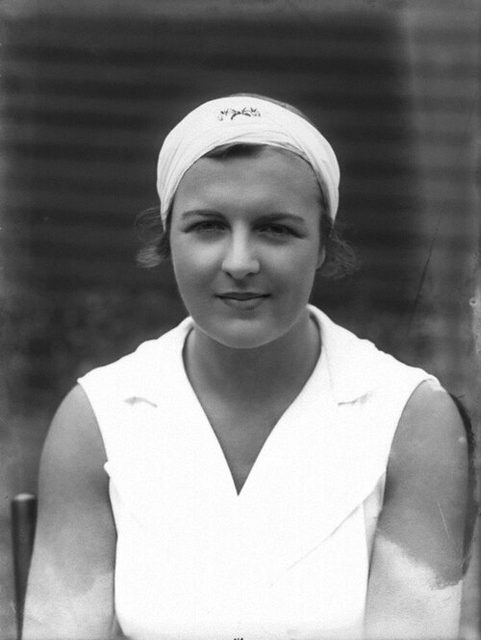
She appeared on the cover of TIME in July 1931, wearing her usual white headband, under the caption "The smile is her mother's idea." Her mother's advice was "Smile, smile and keep on smiling", partly to win over crowds. TIME called her reputedly the most photographed woman in England.
TIME reported that she skipped rope every day, went to bed early and practised mostly with her brothers and sisters. Her father, who had taught her, had died six years earlier; her mother ran the family's small chain of hotels, and her elder brother coached her from the stands at big matches.