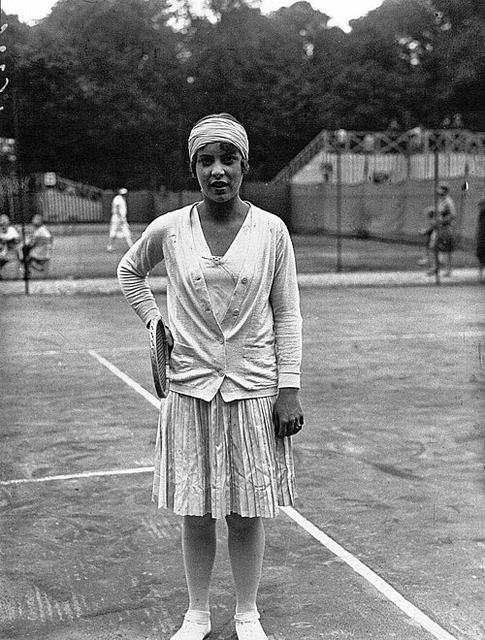
First German, man or woman, to win a Wimbledon singles title
6-2, 7-5
Her 1931 final against Hilde Krahwinkel, the only all-German women's final at Wimbledon
5
Weeks between her French and Wimbledon titles in 1931
2
World ranking at the end of 1931, behind Helen Wills Moody
22
Her age on the day of the Wimbledon final
Playing career
Cäcilia Edith Aussem was born in Cologne on 4 January 1909. Her father ran a food business and the family had money for travel; her mother, Helen, drove the career. In 1923 her mother took her to Rot-Weiss Köln, where the coaches did not at first think her especially gifted. She worked with Roman Najuch and Willi Hannemann, became German junior champion in 1925 and won the first of her German singles titles in 1927.
Her career turned in early 1930, when Bill Tilden took her on as a pupil and mixed doubles partner on the Riviera. That year they won the French mixed doubles together and she reached the Wimbledon semi-finals. In 1931 she won the French singles, beating Betty Nuthall 8-6, 6-1, and five weeks later the Wimbledon singles, beating her compatriot Hilde Krahwinkel 6-2, 7-5. She finished the year second in the world.
A South American tour in late 1931 ended with appendicitis that went untreated for too long, and a long break followed. She also had a chronic eye condition. She came back in 1933, reached the Wimbledon quarter-finals in 1934 and was ranked ninth in the world that year, but never regained her 1931 form, and she stopped playing in 1935. She married the Italian Count Fermo Murari dalla Corte Brà in March 1936, moved with him to East Africa, where she contracted malaria, and later lived in Italy. She died in Portofino on 22 March 1963, aged 54.
On grass
Wimbledon 1930
Seeded sixth, she reached the semi-finals and was level at 4-4 in the third set against Elizabeth Ryan, having lost the first set 3-6 and won the second 6-0, when a fall forced her to retire
Wimbledon 1931
Top seed. Quarter-final: 2-6, 6-2, 6-1. Semi-final: beat Simonne Mathieu 6-0, 2-6, 6-3. Final: beat Hilde Krahwinkel 6-2, 7-5 on 3 July, in a dry summer that left the Centre Court grass almost as hard as asphalt and both finalists visibly tired
Wimbledon 1934
Seeded seventh on her return from illness; reached the quarter-finals and lost to Helen Jacobs
The double of 1931
French champion on clay at Roland Garros on 31 May and Wimbledon champion on grass on 3 July
Leading grass titles only: the grass majors, tour-level grass events since 1968 and the leading grass championships before 1968. † single source; ‡ sources disagree. Roll of champions
"for the almost unparalleled swiftness of her rise to tennis heights against the sort of odds that are seldom overcome"
Anecdotes
The person behind the player.
Hamburg, 1928
The hypnotism row
After Aussem lost at the international championships in Hamburg, her mother accused the winner, Paula von Reznicek, of hypnotising her daughter with evil looks. The two women came to blows, and the fight was reported in The New York Times. Aussem, in tears, told the players comforting her that she was not crying over the defeat but because she had disappointed her mother.
Bill Tilden began coaching her early in 1930 and took the risk, as he later told it, of telling her over dinner how foolish her and her mother's behaviour had been. His lesson was that losing a match was no disgrace, since no one can win all the time. He worked on her footwork, serve, volley and smash, and that spring they won the French mixed doubles together.
After the final the new champion, 22, burst into tears when she was caught on her way to the dressing room by a noisy crowd of autograph hunters. Teddy Tinling, who looked after overseas players at the Championships and stood about two metres tall, picked her up and carried her to safety.
Konrad Adenauer, then mayor of Cologne, sent her a telegram after the Wimbledon win: the whole of Cologne congratulated her, and her home town was proud of her. German sportswriters gave her their Golden Band award for 1931.
She met her future husband, the Italian Count Fermo Murari dalla Corte Brà, at a tournament in Naples in 1933, after a heated argument with him while he was umpiring her match. They married in March 1936.
Bundesarchiv records show that she joined the Nazi Party on 1 May 1933; her membership was struck off in 1936 when she moved abroad. The record came to light in 2018, when Cologne considered naming a street after her, and the proposal was dropped.