Wimbledon doubles titles: 1933 and 1934 with Elizabeth Ryan, 1937 with Billie Yorke
6
Wimbledon singles semi-finals, 1930 to 1937
142
Matches played at Wimbledon, 102 of them won
13
Major titles, two in singles
No. 3
World ranking in 1932
Playing career
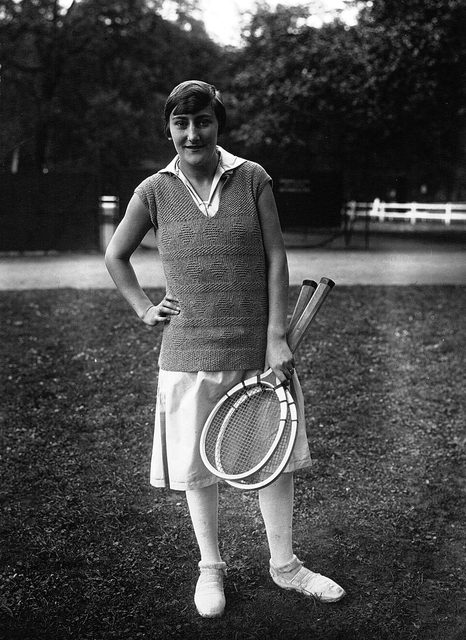
Simonne Passemard was born in Neuilly-sur-Seine on 31 January 1908. She took up tennis at 12 for her health, encouraged by her brother Pierre, a player at the Stade Français, and at 17 married René Mathieu, a journalist and later editor of the tennis magazine Smash. She won the French junior title and became France's leading woman player in 1928, a position she held until 1940.
Her best results in singles came at Roland Garros, where she lost six finals before winning the title in 1938 and 1939. At Wimbledon she reached the singles semi-finals six times between 1930 and 1937 and the quarter-finals in four other years. She was ranked in the world's top ten eleven times. In doubles she won six French titles and three at Wimbledon, two with the American Elizabeth Ryan and one with Billie Yorke of Great Britain, and in 1938 she won the singles, doubles and mixed at the French Championships.
When war broke out in 1939 she was playing in the United States and returned to Europe at once. In London in 1940 she joined the Free French and, with the backing of General de Gaulle, set up and commanded the French Women's Volunteer Corps. She ended the war a captain. Afterwards she ran Smash and published annual tennis guides. She died in Paris on 7 January 1980.
On grass
Wimbledon doubles finals won
1933 with Elizabeth Ryan: beat Freda James and Billie Yorke 6-2, 9-11, 6-4. 1934 with Ryan: beat Doris Andrus and Silvia Henrotin 6-3, 6-3. 1937 with Yorke: beat Phyllis King and Elsie Pittman 6-3, 6-3
Wimbledon finals lost
Doubles 1935 with Hilde Sperling, lost to Freda James and Kay Stammers 6-1, 6-4. Doubles 1938 with Yorke, lost to Sarah Fabyan and Alice Marble 6-2, 6-3. Mixed 1937 with Yvon Petra, lost to Don Budge and Alice Marble 6-4, 6-1
Wimbledon singles
Semi-finalist 1930, 1931, 1932, 1934, 1936 and 1937; quarter-finalist 1933, 1935, 1938 and 1939. In 1931 she lost her semi-final to Cilly Aussem
Leading grass titles only: the grass majors, tour-level grass events since 1968 and the leading grass championships before 1968. † single source; ‡ sources disagree. Roll of champions
"I went everywhere, except to Scandinavia, the Indies and Australia. We had a great life when we were travelling; we were treated like royalty."
Anecdotes
The person behind the player.
Neuilly, 1920
Tennis for her health
At 12 she was in poor health and was told to take regular exercise. She chose tennis, encouraged by her brother Pierre. In 1925, aged 17, she married René Mathieu, son of one of the founders of the Stade Français; she had two sons in 1927 and 1928 and kept playing.
She had a famous temper. After losing her 1931 semi-final to Cilly Aussem she walked off without the traditional handshake. In 1936, after the net cord had sent several balls out of her reach, she threw down her racquet and shouted, according to the Miroir des Sports, "Even this damned net is English!", a word the British took as a serious breach of decorum.
Player's Cigarettes put her on a card in 1936, ready to hit a driving backhand, with the caption: "Note forearm rolled back to open racquet face. Left hand used to steady racquet. Body leaning forward."
In 1940 she went to General de Gaulle and persuaded him to set up a women's auxiliary to the Free French forces. She enrolled in January 1941, commanded the corps, and by 1941 it had more than 100 volunteers. She finished the war as a captain and marched down the Champs-Élysées with de Gaulle at the Liberation of Paris in August 1944.
On 17 September 1944 she sat in the umpire's chair, in her Free French uniform, for the Liberation match between Henri Cochet and Yvon Petra on the Centre Court at Roland Garros. Petra won 6-1, 6-2.
Her first name was unusual, and it was misspelt on the women's doubles trophy at Roland Garros that bears it. The Wimbledon Compendium also spells it Simone. When Roland Garros named its new show court after her in 2019, it made sure the signs were right.