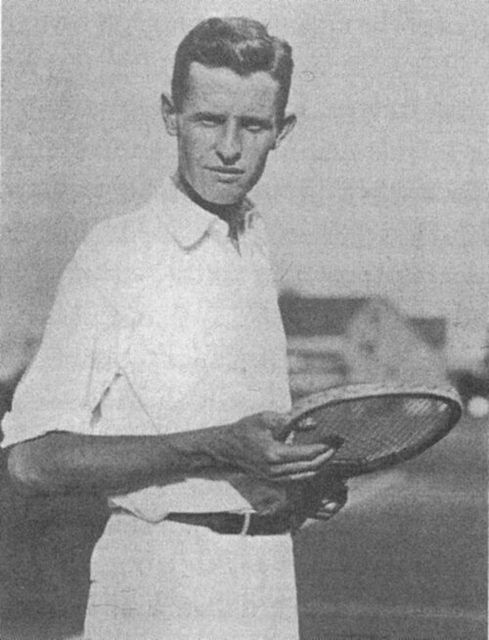
Robert Lindley Murray was born in San Francisco in 1892. At Stanford he captained the tennis team, ran track, won the Pacific Coast intercollegiate title in 1913 and graduated in chemistry that year, adding a master's in chemical engineering in 1914. He went east and in 1914 won the New York Metropolitan title, beating Fred Alexander, and the Meadow Club Cup at Southampton, beating Watson Washburn, to finish fourth in the US rankings.
In February 1916 he won the national indoor title at the Seventh Regiment Armory in New York and joined Hooker Electrochemical in Niagara Falls. Bill Johnston beat him in the 1916 US semi-finals 6-2, 6-3, 6-1. In wartime the championships at Forest Hills became the National Patriotic Tournament, with no trophies and entry fees given to the Red Cross. Murray, reluctant to leave war work, was persuaded by his employer to play, and won in 1917, beating Nat Niles 5-7, 8-6, 6-3, 6-3, and in 1918, beating Bill Tilden 6-3, 6-1, 7-5. He was US No. 1 in 1918 and fourth again in 1919.
He then gave his career to the company, rising to president and chief executive of Hooker Electrochemical and retiring as chairman in 1961. He was inducted into the Hall of Fame in 1958 and died in January 1970.
On grass
US Championships finals
1917: beat Nathaniel Niles 5-7, 8-6, 6-3, 6-3. 1918: beat Bill Tilden 6-3, 6-1, 7-5, losing only three sets in seven rounds
US Championships 1916
Semi-finalist; lost to Bill Johnston 6-2, 6-3, 6-1
Grass tournaments 1914
Won the Meadow Club Cup at Southampton, New York, beating Watson Washburn in straight sets, and the New York Metropolitan title, beating Fred Alexander in five sets
The Patriotic Tournaments
Both his titles came at the wartime National Patriotic Tournaments at the West Side Tennis Club, where no trophies were awarded and entry fees went to the American Red Cross
Leading grass titles only: the grass majors, tour-level grass events since 1968 and the leading grass championships before 1968. † single source; ‡ sources disagree. Roll of champions
"My strong points were a vicious serve, a quick dash to the net, and the ability to volley decisively anything that came near me."
Anecdotes
The person behind the player.
Forest Hills, 1917
The reluctant champion
Murray was hesitant to take time away from Hooker Electrochemical, believing his skills were needed in wartime, and entered the championships only after the company's founder, Elon Hooker, encouraged him. He won with little preparation. Roger Ohnsorg's 2011 biography is titled Robert Lindley Murray: The Reluctant U.S. Tennis Champion.
His opponent in the 1917 final, the Bostonian Nat Niles, was better known as a figure skater, a three-time national champion. Murray beat him in four close sets.
Among Stanford's earliest great players, he captained the tennis team in 1913 and also ran track on the Farm. His biographer describes him as a middle-distance runner and a Phi Beta Kappa chemical engineer.
His first national title came indoors, in February 1916 at the Seventh Regiment Armory in New York, where he beat Alrick Man 6-2, 6-2, 9-7 in the final.