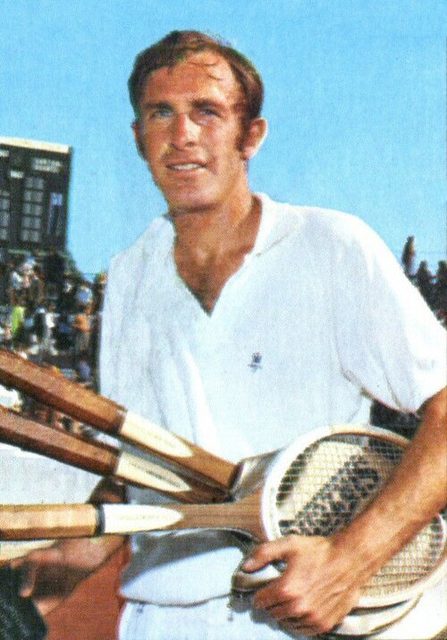
Born in Sydney in 1944, Newcombe won Wimbledon and the US Championships as an amateur in 1967 and was ranked world No. 1 that year by Lance Tingay. In January 1968 he signed a three-year contract with Lamar Hunt's World Championship Tennis as one of the Handsome Eight. He won 26 major titles: seven in singles, 17 in men's doubles and two in mixed. He became ATP No. 1 on 3 June 1974 and in 1975 beat Jimmy Connors 7-5, 3-6, 6-4, 7-6 in the Australian Open final. He played on Australia's Davis Cup winning teams of the 1960s and 1973, and as captain led Australia to the 1999 title against France. He entered the International Tennis Hall of Fame in 1986.
On grass
Major singles titles
7: Wimbledon (1967, 1970, 1971); Australian (1973, 1975); US (1967, 1973)
14 doubles (Wimbledon 6, Australian 5, US 3), 2 mixed (Australian 1, US 1)
Wimbledon doubles
1965, 1968, 1969, 1970 and 1974 with Tony Roche; 1966 with Ken Fletcher. The 1968 final against Ken Rosewall and Fred Stolle went 3-6, 8-6, 5-7, 14-12, 6-3
Wimbledon finals
1967 beat Wilhelm Bungert 6-3, 6-1, 6-1; 1969 lost to Rod Laver 6-4, 5-7, 6-4, 6-4; 1970 beat Ken Rosewall 5-7, 6-3, 6-2, 3-6, 6-1; 1971 beat Stan Smith 6-3, 5-7, 2-6, 6-4, 6-4
Wimbledons missed
1972, barred as two-time holder under the ban on WCT contract players; 1973, with the ATP players' boycott
Leading grass titles only: the grass majors, tour-level grass events since 1968 and the leading grass championships before 1968. † single source; ‡ sources disagree. Roll of champions
"Grass is the best of all surfaces because it changes from day to day."
Anecdotes
The person behind the player.
Sydney · Childhood
The eight-year-old winner
Newcombe won his first competition at about the age of eight, a C-grade Sunday morning men's event in Sydney in which most entrants were adults and the next youngest was about 16. "I was pretty feisty as a kid," he said. He named Frank Sedgman as his first model: "Sedge was the first one who caught my eye."
It was his seventh Wimbledon and he had never reached the quarter-finals. His racquet shook before his first serve of the final and he lost his opening service game, then beat the unseeded Wilhelm Bungert 6-3, 6-1, 6-1. "I found the formula that year of how to survive through two weeks," he said.
Two sets to one and 3-1 up against Ken Rosewall, he lost five games in a row as the crowd swung behind the older man. At the changeover he asked himself, "How badly do you want to win this?" He took the fifth set 6-1. Of his three titles he rated this one highest, since Rosewall had been one of his boyhood heroes.
Diving for a volley in the second set against Stan Smith, he landed on his solar plexus and struggled for breath. He recovered by breathing deeply through the break, came back from two sets to one down and won 6-4 in the fifth.
Newcombe entered as champion of the previous two years, with the chance to become the first man since Fred Perry in 1936 to win three in a row. Because he was under contract to World Championship Tennis, he was not allowed to play. The next year he joined the ATP boycott and stayed away again.
Known everywhere as Newk, he was easy to pick out by his thick moustache, which Australian crowds adored. He described the code he grew up with: "There was kind of a code that you had as an Australian that you never left the court losing." Before each match he rehearsed it in his head for about 45 minutes.