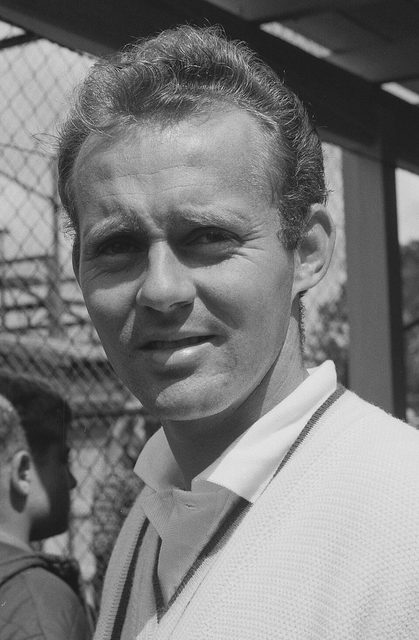
All four major mixed titles in one year with Margaret Smith, the only pair to do it together
10
Major mixed doubles titles, all with Margaret Smith Court
4
Wimbledon mixed doubles titles, 1963 to 1968
12-0
Sets won and lost by Fletcher and Smith at Wimbledon in 1963
Playing career
Kenneth Fletcher was born in Brisbane on 15 June 1940 and went to St Laurence's College there. He played in the same years as many of Australia's greatest players, and although he was in Australia's Davis Cup squad through the 1960s he never played a tie. Harry Hopman called his forehand the best in the world. He reached the singles final of the 1963 Australian Championships, losing to Emerson, was ranked No. 10 in the world in 1966 by Lance Tingay of the Daily Telegraph, and was seeded as high as third at Wimbledon.
His record was made in doubles. In 1963 he and Margaret Smith won the Australian, French, Wimbledon and US mixed titles, and they went on to win ten major mixed titles together, including Wimbledon in 1963, 1965, 1966 and 1968. He won the French men's doubles with Emerson in 1964 and Wimbledon with John Newcombe in 1966.
From 1964 he lived mainly in Hong Kong and later in England, coaching in Hong Kong and at the All England Club. He was declared bankrupt in the 1980s. With his friend Chuck Feeney, the American duty-free businessman and philanthropist, he later helped direct more than $200 million to medical research institutes and universities, mostly in Queensland. He died of cancer in Brisbane on 11 February 2006, aged 65, and was inducted into the Australian Tennis Hall of Fame in 2012.
On grass
Wimbledon mixed finals with Margaret Smith
1963: beat Bob Hewitt and Darlene Hard 11-9, 6-4. 1964: lost to Fred Stolle and Lesley Turner 6-4, 6-4. 1965: beat Tony Roche and Judy Tegart 12-10, 6-3. 1966: beat Dennis Ralston and Billie Jean King 4-6, 6-3, 6-3. 1968: beat Alex Metreveli and Olga Morozova 6-1, 14-12
Wimbledon men's doubles
1966: won as an unseeded pair with John Newcombe, beating Bill Bowrey and Owen Davidson 6-3, 6-4, 3-6, 6-3. Lost finals in 1964 with Roy Emerson, 1965 with Bob Hewitt and 1967 with Emerson
Wimbledon 1967 mixed
Lost the final with Maria Bueno to Owen Davidson and Billie Jean King 7-5, 6-2
Wimbledon 1966 singles
Beat John Newcombe in five sets in the third round, then lost a five-set quarter-final to the eventual champion, Manolo Santana
Australian Championships
1963 singles final: lost to Roy Emerson 6-3, 6-3, 6-1. Men's doubles finals lost in 1963 and 1964 to Hewitt and Stolle, the second 14-12 in the fifth set
Leading grass titles only: the grass majors, tour-level grass events since 1968 and the leading grass championships before 1968. † single source; ‡ sources disagree. Roll of champions
"Fletch and I just clicked. I probably enjoyed playing with him more than anybody I ever played with"
Anecdotes
The person behind the player.
Brisbane, 1950s
The best forehand in the world
Harry Hopman, Australia's Davis Cup captain, called Fletcher's forehand the best in the world. Fletcher himself was known as a larrikin, an irreverent type who lived one day at a time; his childhood friend Hugh Lunn put his exploits into several books and in 2008 wrote his biography, The Great Fletch.
Fletcher left the tour after Australian officials restricted players' overseas travel. Lunn recalled that he told the press: "We don't live in bloody Moscow." Lunn also said that Fletcher did not train and went out gambling the night before his matches.
Fletcher met Chuck Feeney, then building a duty-free business in Hong Kong, in 1967 at the Ladies Recreation Club in Hong Kong. Feeney liked the club because it had no long waiting list and he could bring his children. The two shared an Irish Catholic background and a fondness for schoolboy jokes, and Feeney later called them "two joke-telling amigos".
In Hong Kong Fletcher helped the Jesuits with orphans, taking groups on outings and hosting an annual Christmas dinner at the Grand Hotel, and he paid for the education of three girls from a Sisters of St Paul orphanage. He called the Jesuits "the Rolls-Royce of priests".
By 1990 Fletcher was 50, divorced and bankrupt after a plan for a tennis ranch in Spain failed, and he was coaching housewives in Slough to pay his debts. Over dinner in London he called himself "an old has-been". Feeney, by then a billionaire, told him that the difference between a billionaire and a bankrupt is about a day, and hired him to run tennis weeks at his resorts.
Feeney made Fletcher his scout in Brisbane, but at first few people took them seriously. Lunn said Feeney's answer was to give one institution $20 million so that everyone would want to talk to him; the money went to the Queensland Institute of Medical Research. "Ken was at the heart of bringing the money," Lunn said.