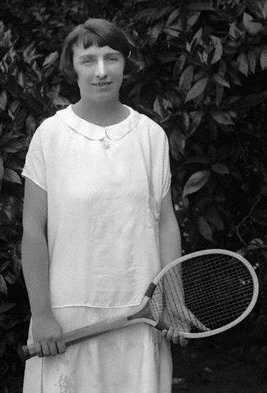
Esna Boyd was born in Melbourne in 1899, the daughter of the Victorian politician James Boyd. She was head prefect at Presbyterian Ladies' College in 1918 and won the Victorian Schoolgirls' Championship the same year. From 1922 to 1928 she reached every Australian women's singles final, winning in 1927, and took eight Australian titles in all: one singles, four doubles and three mixed. She toured with the first Australian women's team to go overseas in 1925 and captained the second in 1928, when she met Angus Robertson, who managed a weaving company in Fife. They married in 1929 and she settled in Scotland, where she won six Scottish hard court titles and played her last tournament at 40. She died in 1966 and entered the Australian Tennis Hall of Fame in 2025.
On grass
Major singles titles
1: Australian (1927)
Major singles finals lost
6: Australian 1922, Australian 1923, Australian 1924, Australian 1925, Australian 1926, Australian 1928
1927: beat Sylvia Lance Harper 5-7, 6-1, 6-2, dropping one set in the event. 1924: lost to Lance Harper 3-6, 6-3, 6-8. 1925: lost to Daphne Akhurst 6-1, 6-8, 4-6
All three titles with John Hawkes: 1922, 1926, 1927
Wimbledon
1925: beat Cristobel Hardie 6-2, 6-0, Millicent Pitt 6-2, 6-2 and Agnes Tuckey 3-6, 6-1, 6-3, then lost the quarter-final to Kitty McKane 6-1, 6-1. Fourth round 1928 and 1930
Overseas tours
Member of the first Australian women's team to tour abroad, 1925; captain of the second, 1928
Leading grass titles only: the grass majors, tour-level grass events since 1968 and the leading grass championships before 1968. † single source; ‡ sources disagree. Roll of champions
"We must practise more aggressive tactics before we can beat the world's best."
Anecdotes
The person behind the player.
Presbyterian Ladies' College, Melbourne
A trophy from Melba
At 14 she won one of four places in the school team, and when she won the school championship the trophy was handed to her by Dame Nellie Melba. She later said the college taught her "to play the game, and to smile when beaten." The school magazine kept reporting her results long after she had moved to Scotland.
Five Australian finals had gone against her, to three different opponents, when she met Sylvia Lance Harper in 1927. She lost the first set 7-5 and then dropped only three games, winning 5-7, 6-1, 6-2. It was the only set she lost in the tournament. A year later Daphne Akhurst beat her in a seventh final.
On the first Australian women's tour, she played Suzanne Lenglen, lost, but took a set from her. Her verdict, in her own words, was blunt: "Suzanne wins half her games on her reputation." She also wrote that the team had been seen off from home with open doubts about its chances, and then won the first tournament it entered.
She captained the second Australian women's team to travel overseas and met Angus Robertson on the trip. They married in March 1929 and she moved to Scotland, where he managed a weaving company in Fife. Her family remembered her as stubborn, and her photographs show a fishing trip to Loch Maree.
In Scotland she won six Scottish hard court titles, one of them while three months pregnant. Her daughter-in-law, Mary Robertson, said of it: "I thought it was frightful." Her son Bill liked to say that he had helped her win.
When Tennis Australia voted her into its Hall of Fame, a century after her first final, it had to search the world for relatives, since her only sister had no children. A great-grandson in Scotland confirmed the line. Three granddaughters flew from the UK and unveiled her bust on Rod Laver Arena. A grandson said: "We knew she was a champion, but we didn't realise how much of a champion she was."