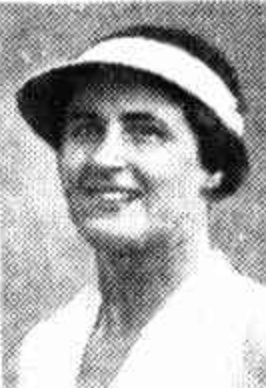
Australia · born South Brisbane, 1894 · died 1985 · the first women's champion of Australasia, in 1922, and Australia's first female professional coach
Australasian singles titles, 1922 and 1923, the first two held
3
Australian doubles titles with Emily Westacott, 1930 to 1934
8
Queensland singles titles, 1922 to 1933
No. 10
World ranking by A. Wallis Myers, 1922 and 1923, the first for an Australian woman
40
Her age on her first trip to Europe, in 1934
Playing career
Maud Margaret Mutch, known as Mall, was born in South Brisbane on 18 October 1894, the eldest of three children of a Scottish-born schoolteacher, Alexander Mutch, who was her first coach. She captained the tennis team at New England Girls' School in Armidale and in 1913 won the Brisbane metropolitan singles and doubles, events she dominated for about 25 years. In 1918 she married Bevil Hugh Molesworth, a history lecturer.
After the war she won the New South Wales singles in 1919 and the Victorian and South Australian titles in 1920. In December 1922 she won the first Australasian women's singles championship at the White City courts at Rushcutters Bay, Sydney, beating Esna Boyd 6-3, 10-8, and she beat Boyd again to defend the title in Brisbane in August 1923. She did not win the singles again, but she reached the 1934 final and won eight Queensland singles titles between 1922 and 1933, three Australian doubles titles with Emily Westacott and fifteen state doubles and mixed titles.
In 1934, aged 40, she made her only tour of Europe, reaching the last 16 of the French Championships and playing Wimbledon, and won the North of England doubles with Joy Mowbray-Green. She retired from championship tennis in 1937, moved to Sydney, and in 1939 became Australia's first female professional coach. She received the British Empire Medal in 1972 for community service in Ku-ring-gai, and died at her home in Lindfield on 9 July 1985.
On grass
Australasian singles finals
1922, White City, Sydney: beat Esna Boyd 6-3, 10-8. 1923, Milton, Brisbane: beat Boyd 6-1, 7-5. 1934, White City: lost to Joan Hartigan 1-6, 4-6
Australian doubles finals
With Emily Westacott: 1930 beat Marjorie Cox and Sylvia Lance Harper 6-3, 0-6, 7-5; 1933 beat Joan Hartigan and Marjorie Gladman 6-3, 6-2; 1934 beat Hartigan and Ula Valkenburg 6-8, 6-4, 6-4. Runner-up in 1923 with Beryl Turner, losing to Boyd and Lance 1-6, 4-6
Australasian mixed
Runner-up 1923 with Bert St John, losing to Sylvia Lance and Horace Rice 6-2, 4-6, 4-6
Wimbledon 1934
Lost in the first round of the singles to Madzy Rollin Couquerque; reached the third round of the doubles with Joan Hartigan
State titles
New South Wales 1919; Victoria and South Australia 1920; Queensland eight times from 1922 to 1933
Leading grass titles only: the grass majors, tour-level grass events since 1968 and the leading grass championships before 1968. † single source; ‡ sources disagree. Roll of champions
"I practised and trained as hard as any boy and loved every minute of it"
Anecdotes
The person behind the player.
Brisbane, 1900s
Coached by her father
Her father, a Scottish-born schoolteacher, taught her the game. Regular practice with male players gave her an aggressive game and a strong serve, and she was described as "the first woman competitor to hit the ball as hard as a man".
She married a history lecturer newly appointed to the University of Tasmania, and in 1920 the couple moved from Hobart to Broken Hill. In those years she won the New South Wales, Victorian and South Australian titles before returning to Brisbane in 1921.
Like most Australian sportswomen of her time she had few chances to play in Europe. When she finally went, in 1934 at the age of 40, she reached the last 16 of the French Championships.
In 1939 she became Australia's first female professional tennis coach, and for some years ran a coaching business in tennis, squash and table tennis from her home in Lindfield, Sydney.
For the centenary of the women's event in 2022, a gold coin bearing her image was used for the coin toss at Australian Open matches, and she was inducted into the Australian Tennis Hall of Fame with a bronze statue in Garden Square. Her great-granddaughter is named Maude after her.