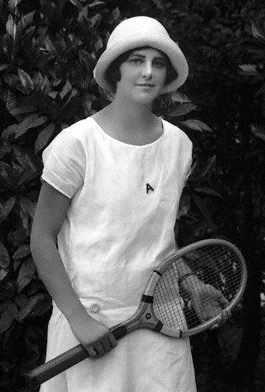
Born in Ashfield, Sydney, in 1903, Daphne Akhurst trained as a pianist and graduated from the State Conservatorium of Music in 1922. She was self-taught at tennis but won the New South Wales schoolgirls' title four years running, 1917 to 1920. She toured Europe with the first Australian women's team in 1925 and won the first of five Australian singles titles that year, adding 1926, 1928, 1929 and 1930. On the second tour, in 1928, she reached the Wimbledon semi-finals and was ranked third in the world. She married Royston Cozens in 1930, retired from serious competition after the 1931 Australian doubles, and died in January 1933, aged 29. Since 1934 the Australian women's champion has received the Daphne Akhurst Memorial Cup.
Jim Willard 1924, 1925; Jean Borotra 1928; Gar Moon 1929
Wimbledon
Singles quarter-final 1925, lost to Joan Fry; semi-final 1928, unseeded, lost to Lili de Alvarez 6-3, 6-0. Doubles semi-final 1928 with Esna Boyd. Mixed final 1928 with Jack Crawford, lost to Elizabeth Ryan and Patrick Spence 7-5, 6-4
Overseas tours
First Australian women's team abroad, 1925; second tour, 1928, when the team won all 13 of its matches
Leading grass titles only: the grass majors, tour-level grass events since 1968 and the leading grass championships before 1968. † single source; ‡ sources disagree. Roll of champions
"those early Australian stonewallers who seemed to have no strokes, but who never got out"
Anecdotes
The person behind the player.
Sydney, 1910s and 1920s
The pianist on court
As a girl she won eisteddfod prizes at the piano, and she graduated from the State Conservatorium of Music in 1922. She taught music and played at concerts and music clubs while winning national titles. Shy and self-effacing off court, she was a determined competitor who still described tennis as "purely a game."
Her first Australian final, against Esna Boyd, went 1-6, 8-6, 6-4. Her play drew cheers loud enough to hold up the men's final on the adjoining court. It was the first of five singles titles in six years, and she kept the Anthony Wilding Memorial Cup outright.
On the first tour she wrote home about the Wimbledon crowds: seats booked months ahead and queues from early morning for standing room. She watched Elizabeth Ryan play Suzanne Lenglen before 15,000 people, the King and Queen among them, in near silence during the rallies. Lenglen lost the first two games and won the next twelve. "The keenness of the public is remarkable," she wrote.
Unseeded, she beat Helen Jacobs in the third round and went on to the semi-finals, where Lili de Alvarez beat her 6-3, 6-0. She also reached the doubles semi-finals with Esna Boyd and the mixed final with Jack Crawford, which they lost to Elizabeth Ryan and Patrick Spence 7-5, 6-4.
The second Australian women's team won all 13 of its matches abroad. Ayres' Almanac ranked Akhurst third in the world, and The Referee went further and called her the best all-round player in the world. At Wimbledon that summer she did better than any of the Australian men.
A year after her death the New South Wales Lawn Tennis Association gave a silver cup in her memory for the Australian women's singles champion. It has been presented every year since 1934. Margaret Court has lifted it 11 times and Serena Williams seven.