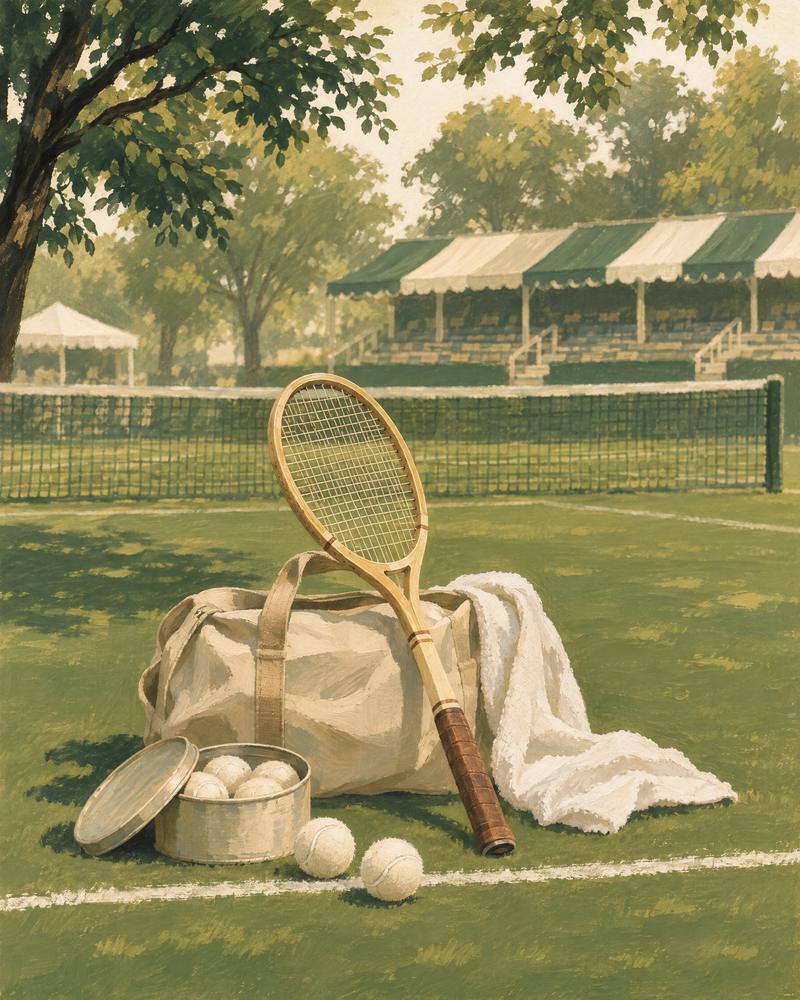
McKinley learned the game in St. Louis, training in winter at a draughty indoor centre at the Armory Building. He played college tennis for Trinity University in San Antonio from 1960 to 1963, losing two of 50 singles matches, and graduated in mathematics in 1964. He reached the Wimbledon final in 1961 and won it in 1963, the year he finished ranked world No. 1. In the United States he won the national clay court title in 1962 and 1963 and the indoor title in 1962 and 1964, and reached three straight semi-finals at the US Championships from 1962. He played Davis Cup from 1960 to 1965, turned down professional offers and joined a New York brokerage firm at 24. He was inducted into the Hall of Fame in 1986 and died a month later, aged 45.
On grass
Wimbledon singles
Champion 1963; runner-up 1961; semi-final 1964, lost to Fred Stolle in four sets; second round 1960 and 1962
Wimbledon finals
1961: lost to Rod Laver 3-6, 1-6, 4-6 in 55 minutes, as a college sophomore and the first American finalist in six years. 1963: beat Fred Stolle 9-7, 6-1, 6-4 in 1 hour 17 minutes
Wimbledon 1963
Seeded fourth, won seven rounds without losing a set. Since Anthony Wilding in 1913, only Don Budge, Tony Trabert, Björn Borg and Roger Federer have done the same
US Championships
Doubles champion 1961, 1963 and 1964 with Dennis Ralston, runner-up 1962. Singles semi-finals 1962, 1963 and 1964
Wimbledon doubles
Quarter-finals 1961, 1962 and 1964
Davis Cup on grass
1963 Challenge Round, Memorial Drive, Adelaide: won the doubles with Ralston and the deciding singles against John Newcombe 10-12, 6-2, 9-7, 6-2, taking the Cup from Australia 3-2
Other grass titles
Eastern Grass Court Championships 1961, beating Frank Froehling
Leading grass titles only: the grass majors, tour-level grass events since 1968 and the leading grass championships before 1968. † single source; ‡ sources disagree. Roll of champions
"The toughest little guy with the sweetest nature I've ever known."
Anecdotes
The person behind the player.
Perth 1960 · Davis Cup
The racquet in the stands
During a Davis Cup match in Australia in 1960 he threw his racquet into the stands. The United States Lawn Tennis Association suspended him for four months, and the episode marked him for years as a player with a temper. Time wrote three years later that his nerves were as taut as the strings of his racquet.
After a bad shot McKinley scolded himself out loud, in the third person, with the same line each time: "Oh, Charley, you missed that one." Time described the rest of his manner as flailing at the ball as if clubbing a rat.
Wilhelm Bungert of West Germany had beaten the top seed, Roy Emerson, in the quarter-final, then lost to McKinley 6-2, 6-4, 8-6. Bungert explained it simply: "I was tired. Tired from those five-set matches earlier. And tired from watching McKinley run."
When he beat Fred Stolle he launched his racquet into the air, leaped the net to shake hands and went up to the Royal Box, in Time's words hippety-hopping, to receive the trophy from Princess Marina, and kissed it. Stolle said McKinley had knocked the ball down his throat until he did not know where to serve.
At 2-2 against Australia he trailed John Newcombe by a set and 2-4 in the third, then came through and finished with a volley at Newcombe's feet. He whooped, jumped the net and was carried off on his teammates' shoulders. "I have always wanted to represent my country in the final match of a Davis Cup and win the deciding point," he said.
He skipped the NCAA Championships because they clashed with Wimbledon, with Trinity's blessing, and in 1963 he put off a $50,000 professional offer to finish his degree. He never did turn professional. At 24 he joined a brokerage firm in New York and left the tour behind.