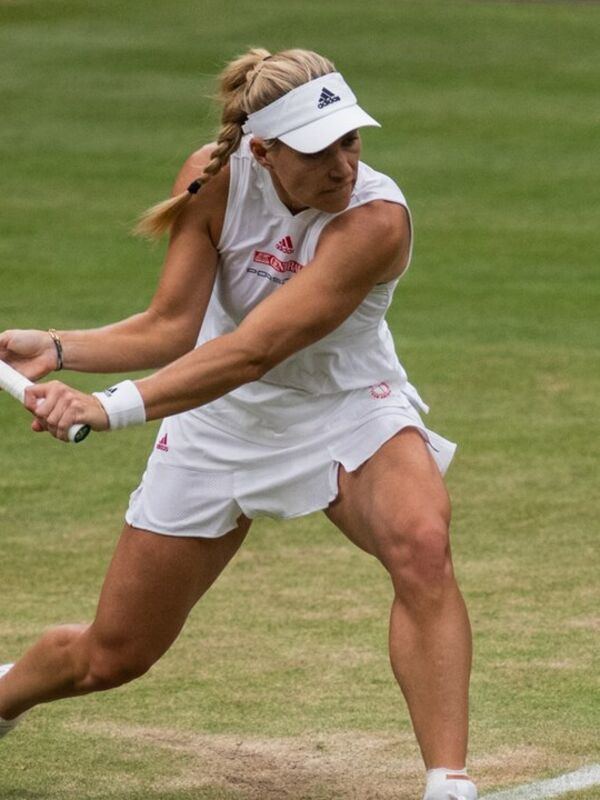
Born in Bremen in 1988 to Polish-German parents, Kerber turned professional in 2003. Her breakthrough came in 2016: she beat Serena Williams in the Australian Open final, won the US Open against Karolína Plíšková, took silver at the Rio Olympics and became world No. 1 on 12 September, the oldest woman at the time to reach the top ranking for the first time. She finished the year at No. 1 and held the ranking for 34 weeks in all. In 2017 she fell to 21st, then won Wimbledon in 2018 for her third major title. She won 14 WTA singles titles and retired after the Paris Olympics in 2024.
On grass
Wimbledon singles
Champion 2018, beating Serena Williams 6-3, 6-3. Runner-up 2016, losing to Williams 5-7, 3-6. Semi-finals 2012 and 2021
Other grass titles
Birmingham 2015, beating Karolína Plíšková 6-7, 6-3, 7-6; Bad Homburg 2021, beating Kateřina Siniaková 6-3, 6-2 in the first edition
Eastbourne
Runner-up three times: 2012 to Tamira Paszek, 2014 to Madison Keys, 2019 to Karolína Plíšková
Finals to remember
Wimbledon 2018: five unforced errors to Williams's 24, four breaks of serve, 65 minutes. The first German woman to win Wimbledon since Steffi Graf in 1996
Leading grass titles only: the grass majors, tour-level grass events since 1968 and the leading grass championships before 1968. † single source; ‡ sources disagree. Roll of champions
"I think without 2017 I would not be here."
Anecdotes
The person behind the player.
Puszczykowo, Poland
Courts built by her grandfather
Her tennis began in Puszczykowo, a town south of Poznań, where her grandfather, Janusz Rzeźnik, built the first courts for his granddaughter. She made the town her home base, and her academy there, managed by her mother, Beata, sits on the edge of Wielkopolski National Park. "I'm so thankful to my grandfather," she said.
The morning after she beat Serena Williams in the Australian Open final, she plunged into the Yarra River, the result of a bet with the Eurosport journalist Matthias Stach. The win made her the first German since 1999 to take a major singles title. "But you must believe that you can do it," she said of the final.
She was eight when Steffi Graf won her last Wimbledon title, and had watched Graf's matches on television and later on YouTube. Before her first Wimbledon final, Graf practised with her and passed on advice. "When you hit with her, she's still playing really well," Kerber said. "Of course, I will try to be the next one to win here after Steffi."
A year after finishing 2016 at No. 1 she reached only one final, lost four matches in a row and ended 2017 ranked 21st. She said the season taught her to look after herself and take time off. Twelve months later she was Wimbledon champion, and said the bad year had made it possible.
Williams was chasing an eighth Wimbledon title and a 24th major. Kerber, who admitted she was "quite nervous before the match", turned to her at the presentation: "Serena, you're a great person, such an inspiration for all of us playing and everyone watching you." She called the win "a dream come true".
At the first Bad Homburg Open she was both tournament ambassador and player. After rain washed out Thursday, she won two three-set matches on Friday, one against Petra Kvitová from a set and 3-1 down, then beat Kateřina Siniaková 6-3, 6-2. It was her first title since Wimbledon in 2018. Playing at home, she said, "always gives me ten, fifteen percent more."