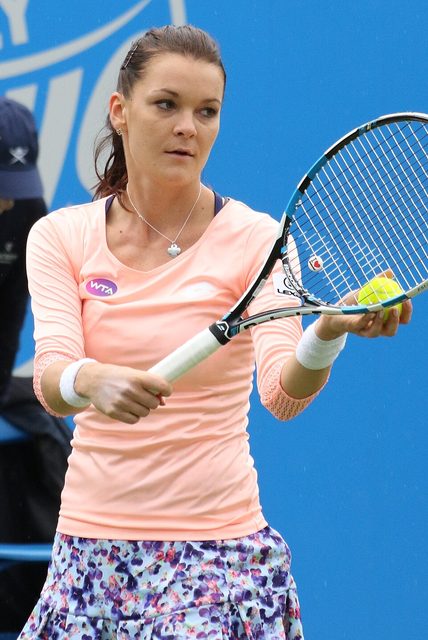
Wimbledon final, the first major final by a Polish player in the Open Era
43-13
Wimbledon singles record, 2006 to 2018
20
WTA singles titles, including the 2015 WTA Finals
No. 2
Career-high ranking, July 2012
2005
Wimbledon girls' singles champion
Playing career
Agnieszka Radwańska was born in Kraków in 1989 and was coached from the age of five by her father, Robert, alongside her younger sister, Urszula. She won the Wimbledon girls' title in 2005 and the French Open girls' title in 2006, and in 2007, in Stockholm, became the first Polish player to win a WTA singles title.
In 2008 she won three titles, Eastbourne among them, and entered the top 10. She reached the Wimbledon final in 2012 and rose to No. 2, and won 20 WTA singles titles in all, including the 2015 WTA Finals in Singapore. Fans voted her the WTA's favourite singles player six years running, from 2011 to 2016. She retired in November 2018, aged 29, saying she could no longer push her body to the limits the sport required, and in December 2024 began coaching her compatriot Magda Linette.
On grass
Eastbourne 2008
Fourth seed; beat Nadia Petrova 6-4, 6-7, 6-4 in the final after missing three match points in the second-set tiebreak and cramping in the third set. Her third title of the season
Eastbourne 2015
Runner-up to Belinda Bencic in three sets, three days before Wimbledon, where she then reached the semi-finals
Wimbledon 2012 final
Beat Maria Kirilenko and Angelique Kerber in the last two rounds, then lost to Serena Williams 6-1, 5-7, 6-2
Wimbledon semi-finals
2013: lost to Sabine Lisicki. 2015: lost to Garbiñe Muguruza
Wimbledon girls' singles
2005: beat Tamira Paszek 6-3, 6-4. Her sister Urszula won the title in 2007; they are the only sisters to have done so
Leading grass titles only: the grass majors, tour-level grass events since 1968 and the leading grass championships before 1968. † single source; ‡ sources disagree. Roll of champions
"In the years since I first joined the WTA Tour, people have called me 'Ninja' or 'The Professor,' and that's the greatest compliment because I want to make those shots that make people ask, 'How did she do that?'"
Anecdotes
The person behind the player.
Kraków, 1990s
Gloves, scarf and hat
She and Urszula practised before school, before the sun was up, in temperatures she put at no more than 30 degrees Fahrenheit; gloves, a scarf and a hat went in the bag with the racquet. Homework was done in their father's car on the way back to the courts after school, and she missed proms and birthday parties.
Her first trophy came at about six, in a skills competition rather than a match: her father fed her balls and she had to hit them to set targets. Speed did not count, only accuracy. "From that moment on, I learned I could play without power and instead use shot selection," she wrote.
She won the girls' final on Centre Court, the court she had grown up watching on television, in two sets against Tamira Paszek. The title, she wrote later, mattered less than the belief it gave her that she might have a future as a professional.
Her final against Nadia Petrova was a struggle for both players: Petrova had treatment for a calf and a hip, and Radwańska cramped in the third set. She missed three match points in the second-set tiebreak, which Petrova won 13-11, before taking the decider 6-4.
Walking out against Serena Williams was, she wrote, surreal. What meant most was "how far I had come from those freezing courts in Poland". No Polish player, man or woman, had reached a major final before.
She announced her retirement at 29 after 13 seasons. "I'm hanging the racquet up and say goodbye to the pro tour, but I'm not leaving tennis," she said, and thanked her fans for "every sleepless night in front of the TV and all those Fan Favorite awards".