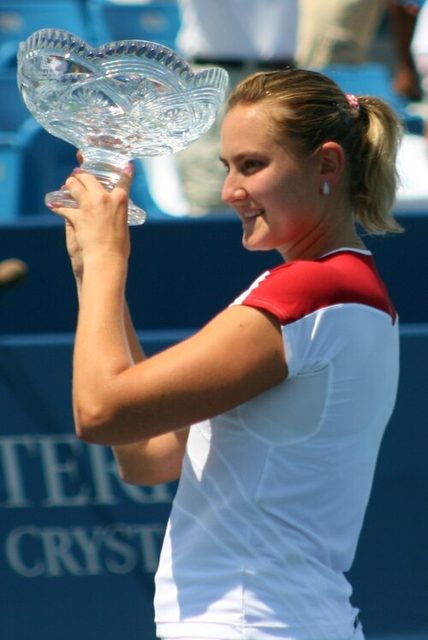
WTA singles titles; 's-Hertogenbosch 2012 was her first on grass
2
Wimbledon singles quarter-finals, 2005 and 2008
Bronze
Olympic women's doubles at Wimbledon, London 2012, with Maria Kirilenko
2
Grass doubles titles: 's-Hertogenbosch 2001 and Eastbourne 2013
Playing career
Nadia Petrova was born in Moscow in 1982 into an athletics family: her mother, Nadezhda Ilyina, won Olympic bronze in a sprint relay in Montreal in 1976, and both parents worked as athletics coaches, which allowed the family to travel. She took up tennis after her parents began watching the Grand Slams on television.
She reached the French Open semi-finals in 2003 and 2005, won the Tier I titles at Charleston and Berlin in 2006 and rose to No. 3 in May 2006. She won 13 singles titles in all and was as successful in doubles, winning the season-ending championships in 2004 with Meghann Shaughnessy and in 2012 with Maria Kirilenko, with whom she also took Olympic bronze in London.
Her mother died in 2013, and Petrova later said this led to her decision to stop before the next Olympics. She played her last professional match in April 2014 and announced her retirement in January 2017.
On grass
's-Hertogenbosch 2012
Seeded eighth, beat the third seed Dominika Cibulková and Kirsten Flipkens, then Urszula Radwańska 6-4, 6-3 in the final for her 11th singles title and first on grass; she was also runner-up in the doubles with Maria Kirilenko
Eastbourne 2008
Lost the final to Agnieszka Radwańska 6-4, 6-7, 6-4, after a second-set tiebreak won 13-11
Wimbledon quarter-finals
2005: seeded eighth, lost to Maria Sharapova 7-6, 6-3. 2008: seeded 21st, lost to Elena Dementieva 6-1, 6-7, 6-3
Grass doubles titles
's-Hertogenbosch 2001 with Ruxandra Dragomir, beating Kim Clijsters and Miriam Oremans 7-6, 6-7, 6-4. Eastbourne 2013 with Katarina Srebotnik, beating Monica Niculescu and Klára Zakopalová 6-3, 6-3
London 2012
Olympic doubles bronze at Wimbledon with Maria Kirilenko; they lost the semi-final to Serena and Venus Williams and beat the top seeds Liezel Huber and Lisa Raymond for the medal
Leading grass titles only: the grass majors, tour-level grass events since 1968 and the leading grass championships before 1968. † single source; ‡ sources disagree. Roll of champions
"Playing at Wimbledon made it even more special because it felt like we'd won a Grand Slam in that bronze medal match."
Anecdotes
The person behind the player.
Moscow, 1980s
A passport through sport
Her parents were athletics coaches for the Soviet Union, which meant the family were among the few who could travel: "The country was closed, so it was only possible to travel through sports." Her mother's stories of the places she had seen gave Petrova a lifelong love of travel.
She wanted to follow her mother into swimming or athletics, but her parents became keen on tennis from watching the Grand Slams on television, "so that was the sport I chose."
Her mother travelled with her until she was about 21 and followed her matches from afar after that. After a defeat, Petrova said, she would hear: "This wasn't good enough; the next one has to be better." She would prepare her reasons for losing before they spoke.
Her mother watched every Olympic match in London and was proud of the medal, but told her that while it was great she had won a bronze like her, the next one needed to be better.
Petrova, the 13th seed, was the last of four Russians beaten in a row by the 17-year-old American Melanie Oudin on her run to the 2009 US Open quarter-finals.