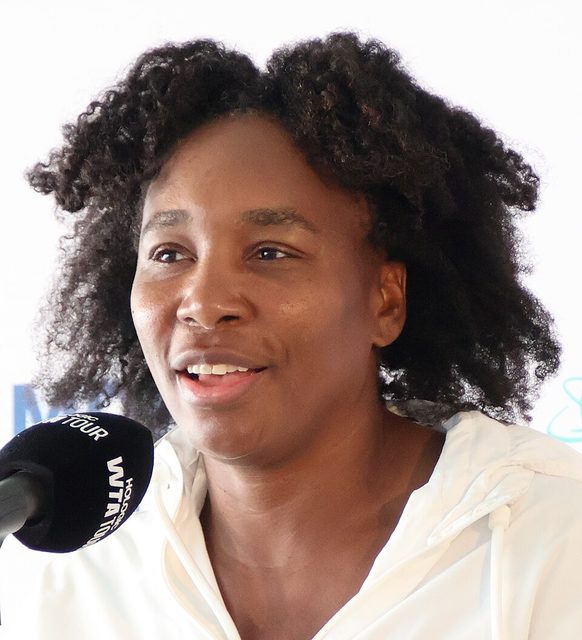
2005 final, the longest women's final at Wimbledon
37
Her age at the 2017 Wimbledon final
Playing career
Born in Lynwood, California, in 1980, Williams won seven major singles titles, five at Wimbledon and two at the US Open, and first reached world No. 1 in February 2002. She has won 49 singles titles and, with her sister Serena, 14 major doubles titles, and she took Olympic gold in singles at Sydney in 2000 and in doubles with Serena in 2000, 2008 and 2012. Her campaign for equal prize money helped bring it to Wimbledon in 2007, and that year she became the first women's champion paid the same as the men's. She reached her ninth Wimbledon singles final in 2017, aged 37. In 2026, aged 46, she returned to Wimbledon for the first time since 2023 and lost in the first round of the mixed doubles with Kevin Krawietz, 6-4, 6-4.
2002, 2003 and 2009 to Serena Williams; 2017 to Garbiñe Muguruza 7-5, 6-0
Wimbledon doubles
2000, 2002, 2008, 2009, 2012 and 2016, all with Serena Williams
Olympic doubles 2012
Gold at the All England Club with Serena Williams, beating Andrea Hlaváčková and Lucie Hradecká 6-4, 6-4 in the final
Wimbledon 2026
Mixed doubles first round with Kevin Krawietz, lost to Lloyd Glasspool and Tereza Mihalíková 6-4, 6-4; the women's doubles with Serena was not played after Serena injured a knee
Leading grass titles only: the grass majors, tour-level grass events since 1968 and the leading grass championships before 1968. † single source; ‡ sources disagree. Roll of champions
"I was the 14th seed; I wasn't supposed to win. But I always bet on myself."
Anecdotes
The person behind the player.
Wimbledon 2004
The point nobody noticed
In a second-set tiebreak against Karolina Šprem, the umpire, Ted Watts, announced 2-2 when a line judge had called a fault, giving Šprem a point she had not won. Nobody challenged it, and Šprem won 7-6, 7-6. Williams would not blame him: "I don't think one call makes a match," she said. "I don't question a lot of calls."
On the eve of the final against Lindsay Davenport, Williams went before the Grand Slam committee to argue that women should be paid the same as men. The next day she won the longest women's final in Wimbledon history. That year the men's champion received £630,000 and the women's champion £600,000.
When nothing had changed a year later, she set out her case in The Times. "The message I like to convey to women and girls across the globe is that there is no glass ceiling," she wrote. "My fear is that Wimbledon is loudly and clearly sending the opposite message." In February 2007 the club announced equal prize money.
Seeded 23rd, she beat Marion Bartoli 6-4, 6-1 in the final and became the first woman to take home a winner's cheque the same size as the men's, £700,000. Roger Federer collected the same amount the following day. Two years earlier the gap between the two champions had been £30,000.
With Wimbledon's courts used for the London Olympics, she and Serena won the doubles final 6-4, 6-4 against Andrea Hlaváčková and Lucie Hradecká, a repeat of that summer's Wimbledon final. It was the fourth Olympic tennis gold for each sister, a record.
Three years after her last Wimbledon, she returned on a wild card in the mixed doubles with Kevin Krawietz and played on Court 14. "At this age, it's great that she's still playing at this level and wants to play and enjoy the sport," Krawietz said. They lost 6-4, 6-4 to the seventh seeds.