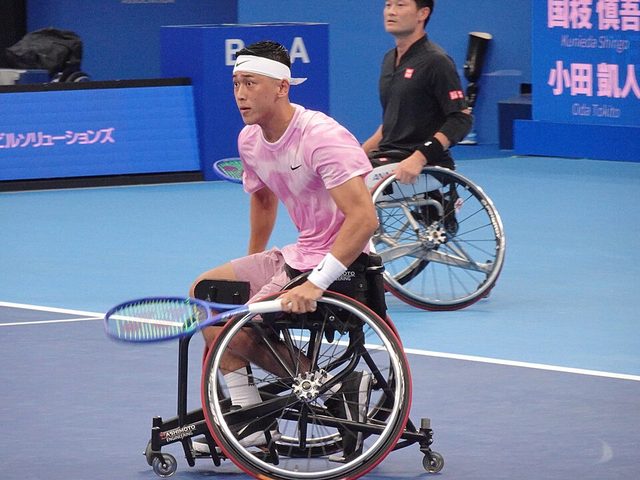
Born in Ichinomiya, Aichi, in 2006, Oda took up wheelchair tennis at nine and grew up watching Shingo Kunieda on television. He was named ITF Wheelchair Junior of the Year in 2021. In 2023 he won the French Open at 17 years and 33 days, the youngest man of the Open Era to win a major in any discipline, and became world No. 1 that June. At the Paris Paralympics in 2024 he won singles gold and doubles silver, and his 2025 US Open title completed a career Golden Slam. By the 2026 US Open, where he lost the final, he held ten major singles titles, six of them won in a row. In 2026 he won Wimbledon for a third time, beating Alfie Hewett 6-1, 6-1, and took his first British Open title at Roehampton.
On grass
Major singles titles
3: Wimbledon (2023, 2025, 2026)
Other grass singles titles
1: British Open (2026)
Wimbledon doubles
Finalist 2023 and 2024 with Takuya Miki, 2026 with Gustavo Fernández; all three lost to Alfie Hewett and Gordon Reid
Leading grass titles only: the grass majors, tour-level grass events since 1968 and the leading grass championships before 1968. † single source; ‡ sources disagree. Roll of champions
"He was my hero and I looked up to him and now someone will look up to me."
Anecdotes
The person behind the player.
Wimbledon 2023 · Court No. 1
Sparkling water instead
At 17 years and 69 days he beat Alfie Hewett 6-4, 6-2 to become the youngest man to win a Wimbledon title in any discipline. He told the crowd he wanted to open champagne but was too young, so sparkling water would have to do. The crowd laughed, and he stayed on court a long time afterwards for selfies and signing balls.
Trailing the defending champion Hewett by a set, he won 3-6, 7-5, 6-2 after 2 hours 16 minutes for his second Wimbledon title. He took the partisan atmosphere in good part: "Maybe 100% of the people were cheering for Alfie, but I really enjoyed that moment. I'm really happy right now."
After beating Hewett 6-1, 6-1 he arrived giggling at his press conference, set the trophy on the desk and watched it topple. "It looks like art right now," he said. Having just turned 20, the legal drinking age in Japan, he had finally opened champagne and shared it with his team.
He had watched Shingo Kunieda's Paralympic finals on television and missed selection for Tokyo, finishing fifth in Japan. In Paris, with Kunieda in the stands, he beat Hewett for singles gold, tore the wheels off his chair and lay on the clay with his arms spread. Kunieda told him afterwards: "You are too good."
"Before I got sick, I played soccer," he said at 15, adding that he had loved ball sports all his life and found martial arts helpful for tennis. He named Tom Egberink and Takashi Sanada as players he studied, and practised on two weekday evenings after school. His satisfaction with his game, he said, was close to zero.