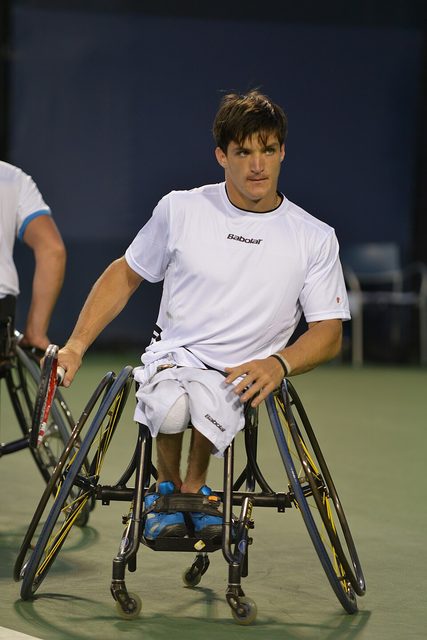
Born in Río Tercero, Córdoba, in 1994, Fernández took up tennis as a child and was 12 when he found videos of Shingo Kunieda on YouTube. He won five major singles titles: Roland Garros in 2016 and 2019, the Australian Open in 2017 and 2019, and Wimbledon in 2019. He first became world No. 1 on 10 July 2017 and was ITF world champion that year. He took Parapan American singles gold in 2011, 2015 and 2019, and after three Paralympic quarter-finals won singles bronze in Paris in 2024. In doubles he has won majors with Nicolas Peifer, with Kunieda, and with Tokito Oda at the 2025 US Open and the 2026 Australian Open.
On grass
Major singles titles
1: Wimbledon (2019)
Major singles finals lost
2: Wimbledon (2017, 2018)
Major doubles titles
2: Wimbledon (2015, 2022)
Other grass singles titles
1: British Open (2024)
Wimbledon doubles
2015 with Nicolas Peifer; 2022 with Shingo Kunieda; runner-up in 2026 to Alfie Hewett and Gordon Reid
Wimbledon singles finals
2017: lost to Stefan Olsson 5-7, 6-3, 5-7. 2018: lost to Olsson 2-6, 6-0, 3-6. 2019: beat Shingo Kunieda 4-6, 6-3, 6-2
British Open, Roehampton
Singles champion 2024, the first year on grass, after Alfie Hewett withdrew from the final; runner-up 2025, lost to Hewett 6-2, 4-6, 4-6
Match to remember
Wimbledon 2017 semi-final: beat Alfie Hewett 4-6, 7-6, 6-3 to reach his first grass final
Leading grass titles only: the grass majors, tour-level grass events since 1968 and the leading grass championships before 1968. † single source; ‡ sources disagree. Roll of champions
"It is good to win but it is only tennis and life goes on."
Anecdotes
The person behind the player.
Wimbledon 2019 · Final
Beating the YouTube hero
At 12 he learnt about wheelchair tennis from videos of Shingo Kunieda. "He changed the sport," he said. Thirteen years later he met Kunieda in the Wimbledon final, lost the first set, and won 4-6, 6-3, 6-2 in over two hours. He called the two lost finals before it "part of the process".
In the third set against Alfie Hewett his racquet flew out of his hand in the middle of a rally. Losing the racquet usually costs the point, but the shot he had just played was too hard for Hewett to reach. Fernández won the point, then the match 4-6, 7-6, 6-3, and went through to his first Wimbledon final.
His father, Gustavo "Lobo" Fernández, played professional basketball in Argentina and had just been named coach of Boca Juniors when the family flew to London for the final. Wimbledon's website was showing clips of the son's dives for the ball. "He's a tough one," the father said. "I don't know who he takes after."
When his biography was published he was surprised that Rafael Nadal agreed to write the foreword. He said his Grand Slam titles were very personal to him, and admitted that he and his coach, Fernando San Martín, fought a lot, but only because both wanted him to be as good as he could be.
He missed the Australian swing that year to look after his wellbeing, then came back to win the British Open on grass at Roehampton and beat Gordon Reid, the home player who had knocked him out a year earlier, in the first round at Wimbledon. "This is the year I have grown the most," he said.
He went out in the singles quarter-finals at the London 2012, Rio 2016 and Tokyo Paralympics. In Paris, at his fourth Games, he finally won a medal, singles bronze, the first Paralympic wheelchair tennis medal won by a player from South America.