ATP singles titles, one of them on grass at Queen's
6
Wimbledon quarter-finals or better, 1981 to 1989
SF
Wimbledon 1982, unseeded
1988
Olympic singles silver medal, Seoul
Playing career
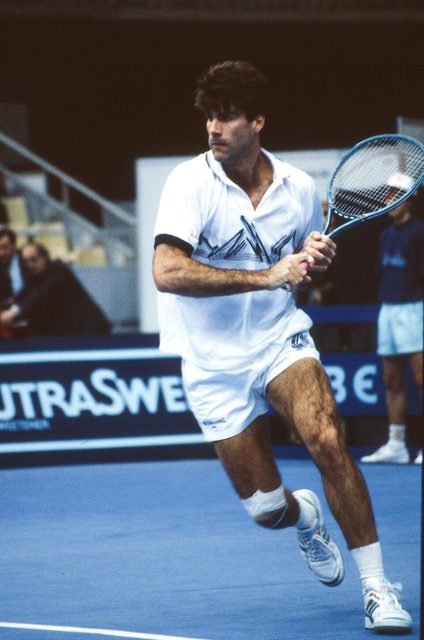
Tim Mayotte was born in Springfield, Massachusetts, in 1960, the youngest of seven children in a tennis-playing family, and learned the game on the public courts of Forest Park. At Stanford he won the 1981 NCAA singles title and the Rafael Osuna Award for sportsmanship, then left without finishing his history degree to turn professional and was named the tour's Newcomer of the Year.
A tall serve-and-volleyer, he reached the Wimbledon quarter-finals on his debut in 1981 and the semi-finals, unseeded, in 1982, and the Australian Open semi-finals in 1983. His first ATP title came at the inaugural Lipton International Players Championships in 1985, the year he also reached the WCT Finals. He won Queen's in 1986 and the Paris Indoor title in 1987, took the singles silver medal at the 1988 Seoul Olympics and reached No. 7 that October. He reached the US Open quarter-finals in 1989, won his 12th and last title in Washington that summer, and retired in 1992.
He later coached, joining the USTA as a national coach in 2009 and speaking out about the standard of American coaching. He has run a junior academy outside Boston and worked as a volunteer assistant coach at Harvard.
On grass
Queen's 1986
Beat the defending champion Boris Becker in the quarter-finals and Jimmy Connors in the final, 6-4, 2-1, when Connors retired
Wimbledon 1982
Unseeded, beat the 11th seed Brian Teacher 6-7, 7-6, 7-5, 3-6, 6-1 in the quarter-finals; lost the semi-final to John McEnroe 6-3, 6-1, 6-2 on No. 1 Court
Wimbledon quarter-finals
1981 on his debut, 1983 as 16th seed, 1986, 1988 and 1989; he reached the second week nine times in eleven visits from 1981 to 1991
Wimbledon 1985
Seeded 16th, lost a dramatic fourth-round match to Boris Becker, who took a heavy fall in the fourth set, recovered and went on to win the title
Other grass finals
Lost to John Alexander at Bristol in 1982 and to Vijay Amritraj at Newport in 1984, 3-6, 6-4, 6-4
Leading grass titles only: the grass majors, tour-level grass events since 1968 and the leading grass championships before 1968. † single source; ‡ sources disagree. Roll of champions
"It isn't just about teaching American players better fundamentals. It's about teaching coaches those fundamentals."
Anecdotes
The person behind the player.
Springfield, Massachusetts
Public courts
Springfield is the birthplace of basketball, but the Mayottes were a tennis family. Tim, the youngest of seven children, learned on the public courts of Forest Park.
The British press named him Gentleman Tim during his first Wimbledon, when he reached the quarter-finals. His Stanford coach Dick Gould put him in the company of Ken Rosewall, Stan Smith and Arthur Ashe: players who "can compete like crazy, but within perspective".
After winning a tournament in Manchester in June 1983 he was reported to have called for players' bad behaviour to be punished, including a suspension for John McEnroe, a fellow Stanford man. The story made headlines in England. His brother-in-law, a Boston lawyer, said he had been substantially misquoted and had not been aiming at McEnroe in particular.
Mayotte said his real tennis education began only after he stopped playing in 1992. He has since worked on a book on technique he calls The Framework, arguing that coaches focus too much on a player's swing in isolation: "We have a fetish for Federer's forehand swing, but as far as what you can learn from it alone, it's useless."