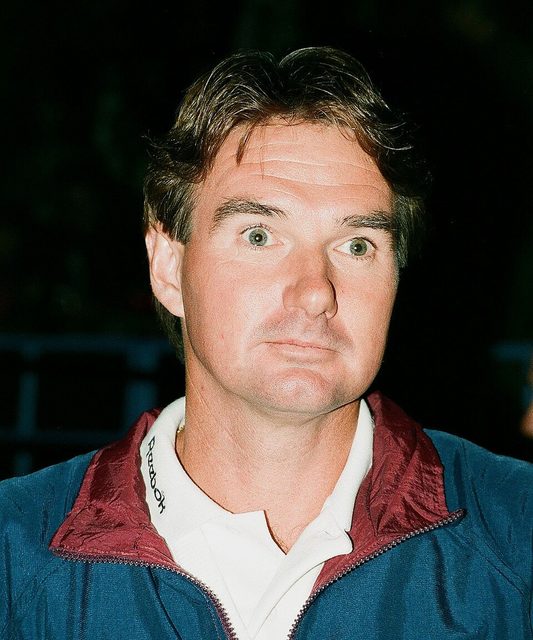
Born in East St. Louis, Illinois, in 1952, Connors was taught by his mother, Gloria, to hit the ball on the rise, and from 1968 worked with Pancho Segura in Southern California. He turned professional in 1972 and won eight major singles titles: the US Open five times, Wimbledon twice and the Australian Open once. In 1974 he won three of the four majors and went 93-4. He is the only player to win the US Open on grass, clay and hard courts. He held the No. 1 ranking for 268 weeks, finished five years running at the top from 1974 to 1978, and set Open Era men's records of 109 singles titles and 1,274 match wins. At 39 he reached the 1991 US Open semi-finals. He entered the Hall of Fame in 1998.
On grass
Major singles titles
4: Wimbledon (1974, 1982); Australian (1974); US (1974)
5: Queen's 3 (1972, 1982, 1983); Birmingham (1978); Manchester (1974)
Major doubles titles
1 doubles (Wimbledon 1)
Wimbledon doubles
1973 with Ilie Năstase, beating John Cooper and Neale Fraser 3-6, 6-3, 6-4, 8-9, 6-1 in the year of the ATP boycott
Finals to remember
1974: beat Ken Rosewall 6-1, 6-1, 6-4. 1982: beat John McEnroe 3-6, 6-3, 6-7, 7-6, 6-4, after standing three points from defeat in the fourth-set tiebreak, eight years after his first title
Wimbledon 1975
Lost the final as top seed to Arthur Ashe 6-1, 6-1, 5-7, 6-4, against soft, low balls and serves sliced wide to his backhand
Leading grass titles only: the grass majors, tour-level grass events since 1968 and the leading grass championships before 1968. † single source; ‡ sources disagree. Roll of champions
"Borg and I were fire and ice. We were just entirely different people on and off the court."
Anecdotes
The person behind the player.
Wimbledon 1977 · Centenary
Missing from the parade
On the opening day of the centenary Championships, former champions paraded on Centre Court. Connors stayed away, practising in the grounds with Ilie Năstase, and was booed for it, a rare thing at Wimbledon. In his 2013 memoir he gave his side: the club would not let his doctor in to fit a splint for an injured thumb, and by the time it was done he was too late.
Connors was engaged to Chris Evert, and in 1974 both won the Wimbledon singles titles, a pairing the press called the Lovebird Double. The engagement was broken off shortly before the 1975 Championships, and two brief reconciliations followed, in 1976 and 1978.
Gloria Connors, a tennis teacher, was his first coach, and in Los Angeles she waited tables to help pay the rent. When he first beat her in a set, at 15, he ran to the net in tears and apologised. Her answer, as he told it: "This is the moment I've been waiting for. Now I know you're ready to move on."
Connors came to the final in the middle of a $40 million lawsuit against Arthur Ashe, dropped soon afterwards. Ashe walked out in a navy Davis Cup jacket with U.S.A. on it; Connors, who had not yet played Davis Cup, wore a white Sergio Tacchini. Down 3-0 in the second set, Connors called out: "I'm trying, for crissake!"
On his 39th birthday, in the fourth round against Aaron Krickstein, Connors disputed a call with the umpire, David Littlefield: "He called the ball good, you didn't see the God darn ball." The umpire did not report him. Connors came back from 5-2 down in the fifth set to win and reached the semi-finals.
Bud Collins named him the Brash Basher of Belleville, after the St Louis suburb where he grew up. Connors fed on the energy of crowds, friendly or hostile, and used it in many of his best matches. He called his 2013 autobiography The Outsider.