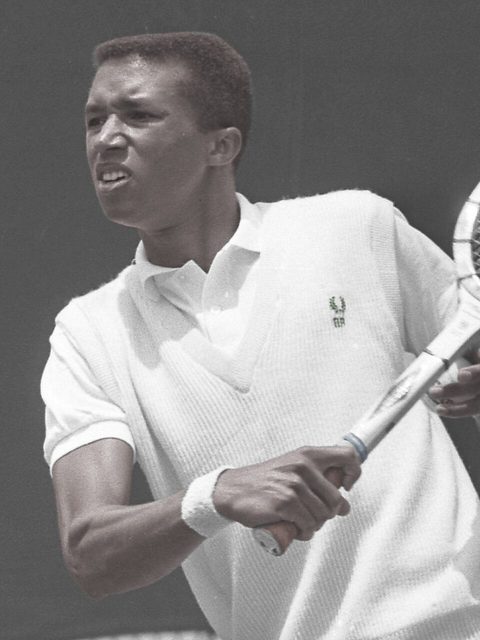
Born in Richmond, Virginia, in 1943, Ashe began on a segregated playground and from 14 was mentored by Dr Robert Johnson, who had also coached Althea Gibson. At UCLA he won the 1965 NCAA singles and doubles titles. In 1963 he became the first Black player chosen for the US Davis Cup team, and he won 27 of his 32 Davis Cup singles matches. While serving in the Army, and still an amateur, he won the first US Open in 1968, then the 1970 Australian Open and Wimbledon in 1975, a year several experts ranked him world No. 1. He helped found the ATP in 1972 and became its president in 1974. Heart trouble ended his playing career in 1980; he captained the US Davis Cup team from 1981, campaigned against apartheid and died in New York in 1993.
On grass
Major singles titles
3: Wimbledon (1975); Australian (1970); US (1968)
Major singles finals lost
4: Australian 1966, Australian 1967, Australian 1971, US 1972
Other grass singles titles
7: Queensland Championships 2 (1965, 1968); Eastern Grass Court Championships (1964); Kent Championships (1975); Pennsylvania Championships (1968); SA Championships (1965); West of England (Bristol) (1968)
Major doubles titles
1 doubles (Australian 1)
Finals to remember
US Open 1968: beat Tom Okker 14-12, 5-7, 6-3, 3-6, 6-3 with 26 aces. Australian 1970: beat Dick Crealy 6-4, 9-7, 6-2. Wimbledon 1975: beat Jimmy Connors 6-1, 6-1, 5-7, 6-4
Wimbledon 1975 run
Beat Björn Borg in the quarter-final and Tony Roche 5-7, 6-4, 7-5, 8-9, 6-4 in the semi-final, as sixth seed
Wimbledon singles
Semi-finals in 1968 and 1969 before the 1975 title
Leading grass titles only: the grass majors, tour-level grass events since 1968 and the leading grass championships before 1968. † single source; ‡ sources disagree. Roll of champions
"When I walked on court, I thought I was going to win."
Anecdotes
The person behind the player.
US Open 1968
Champion on expenses
Ashe won the first US Open with 26 aces against Tom Okker, but to keep his Davis Cup eligibility and his Army place he had stayed an amateur. The $14,000 first prize went to Okker, the runner-up, and Ashe received $20 a day in expenses. He also won the US Amateur that year, the only man to win both.
Donald Dell wrote the agreed tactics on a hotel notepad and left it in Ashe's mailbox. After the third game of the final Ashe took the paper from his racquet cover and read it at the changeovers. Some in the crowd thought he was meditating. Connors, for his part, had notes from his late grandmother tucked into his sock.
Connors' camp had filed suit over comments Ashe made as ATP president, criticising Connors for staying away from the Davis Cup. Ashe walked on to Centre Court in his navy Davis Cup jacket with U.S.A. in red, and wore red, white and blue wristbands. Connors had never played Davis Cup. The suit was dropped soon after the final.
He started at seven on Brookfield Park, a segregated playground near his home in Richmond. At 14 he found a mentor in Dr Robert Johnson, who had also coached Althea Gibson. The boy from the segregated playground later co-founded the National Junior Tennis League.
South Africa had refused his visa applications since 1969. When one was granted in 1973 he played the South African Open, lost the singles final to Connors and won the doubles with Tom Okker. In 1977 he said he had been wrong to go, backed the boycott and later co-founded Artists and Athletes Against Apartheid with Harry Belafonte.
He spent years on A Hard Road to Glory, a three-volume history of African-American athletes published in 1988, and said it mattered more than any of his tennis titles. His memoir, Days of Grace, was finished less than a week before he died in 1993.