Players in the first draw, each paying one guinea to enter
48
Minutes for the 1877 final against William Marshall
200
Spectators, roughly, at the first final
12
Guineas in prize money, with The Field's silver cup
Playing career
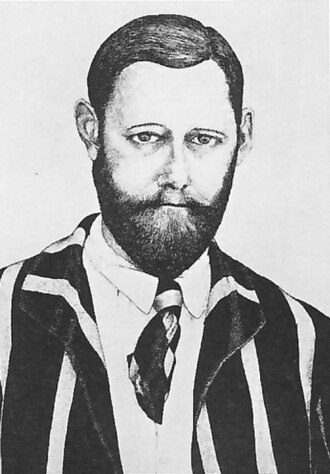
Spencer William Gore was born at Wimbledon on 10 March 1850 and grew up within a mile of the All England Croquet Club. His father, the Hon. Charles Alexander Gore, was a Commissioner of Woods and Forests; his brothers included Charles Gore, the theologian and later bishop. At Harrow he was an all-round games player and captained the cricket XI in 1869. He played first-class cricket for Surrey in 1874 and 1875 and later for I Zingari and the Gentlemen of the South.
In July 1877 he entered the first lawn tennis championship at the All England Club, a field of 22. He beat M. Hankey, F. Langham and C. G. Heathcote, then William Marshall 6-1, 6-2, 6-4 in the final on 19 July, in 48 minutes, before about 200 people on a damp afternoon. He won by going to the net and volleying, against opponents brought up on real tennis.
In 1878, under the new Challenge Round system, he had only to defend his title in one match. Frank Hadow beat him in straight sets by lobbing over his head, and Gore, who was playing with a sprained wrist, never played at Wimbledon again. He worked as a surveyor and land agent and became a partner in the firm that took the name Smiths Gore. His son Spencer Frederick Gore became a painter and the first president of the Camden Town Group. Gore died at the Granville Hotel, Ramsgate, on 19 April 1906, aged 56.
On grass
Wimbledon 1877
Beat M. Hankey, F. Langham and C. G. Heathcote, then William Marshall 6-1, 6-2, 6-4 in the final. Play was paused on 13 and 14 July for the Eton v Harrow cricket match at Lord's, and the final was played on 19 July on damp, slippery courts
Challenge Round 1878
Lost to Frank Hadow 7-5, 6-1, 10-8 (the Compendium score; other sources give 9-7 in the third) before about 700 spectators. The Badminton Library noted that Gore was suffering from a sprained wrist
Style
The Badminton Library's lawn tennis section, edited by C. G. Heathcote, whom Gore beat in 1877, said that Gore's volley "was his own creation" and that he was the first to see the need to force his opponent to the back line before coming to the net. His underhand service had "an extraordinary power of twist"
Prize
12 guineas and the Field Cup, a 25 guinea silver cup given by The Field newspaper, the original men's singles trophy from 1877 to 1883
Leading grass titles only: the grass majors, tour-level grass events since 1968 and the leading grass championships before 1968. † single source; ‡ sources disagree. Roll of champions
"That anyone who has really played well at cricket, tennis, or even rackets, will ever seriously give his attention to lawn tennis, beyond showing himself to be a promising player, is extremely doubtful; for in all probability the monotony of the game as compared with the others would choke him off before he had time to excel in it."
Anecdotes
The person behind the player.
Wimbledon, July 1877
Paused for the cricket
The first Championship was suspended over 13 and 14 July so that it would not clash with the Eton v Harrow match at Lord's. Rain then delayed the final, which Gore won on damp, slippery courts in front of about 200 people.
Writing in 1890, Gore described his own downfall in the third person: in 1878 "the winner of the championship defeated this net-volleying by simply tossing the ball over the volleyer's head; and the effort of running back so far after the tossed ball completely tired out the volleyer."
After a year of lawn tennis Gore took lessons in real tennis, expecting that "after about an hour's play I should be a match for my would-be teacher". He wrote that "a short five minutes, however, sufficed to disabuse me of my illusion". He decided the fifth class must be the summit of his ambition, and from then on there was only one tennis for him.
Gore captained the Harrow cricket XI in 1869, and Harrow School keeps a team photograph from that year's match against Eton with Gore in the front row. Frank Hadow, the man who took his title, was also an Old Harrovian.
Gore was a partner in his father-in-law's firm, later Smiths Gore, and the 1881 census recorded him as Crown Receiver and Surveyor. He is also credited with writing a popular song, "Jerry", in 1885. In 1904 his business ran into difficulty, a bankruptcy notice followed in March 1906, and he died at the Granville Hotel, Ramsgate, the next month, leaving an estate of £100.