The early years

Frank Hadow

Great Britain · born Regent's Park, London, 1855 · died 1946 · Wimbledon champion 1878 without losing a set

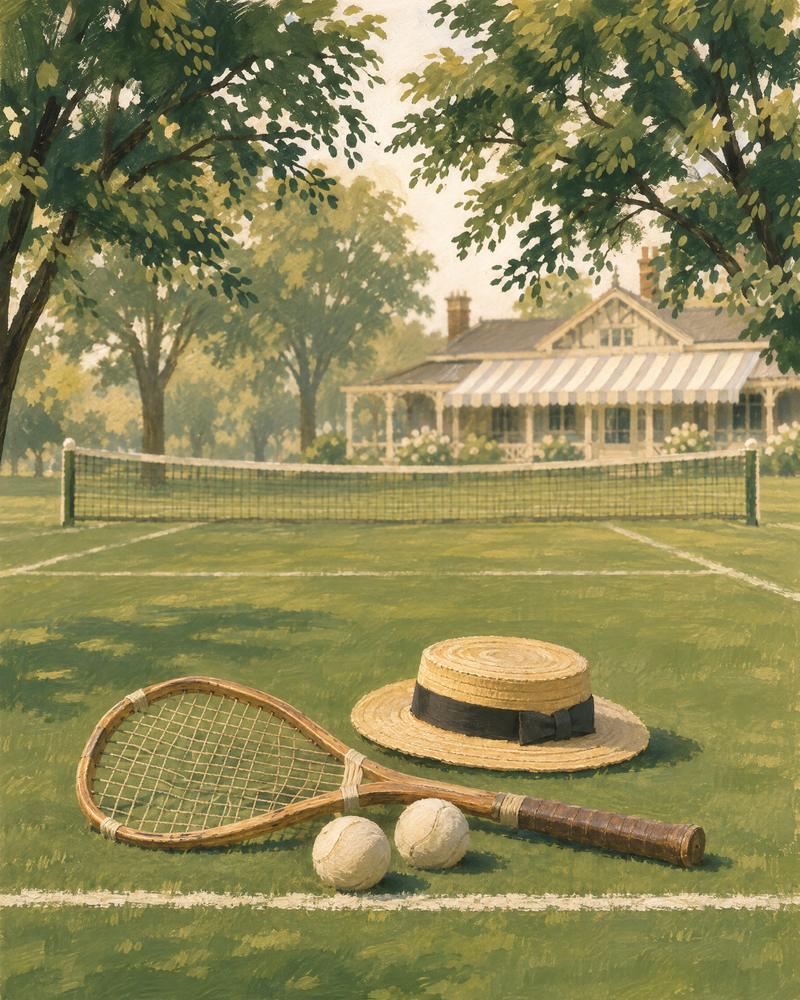
A painted still life of a grass court in the early years, not a portrait of the player
A period scene. No freely licensed photograph of this player has been found yet.

1878

Wimbledon champion, at his only Championships

0

Sets lost at Wimbledon, a record no other men's champion shares

34

Players in the 1878 draw

700

Spectators, roughly, at the Challenge Round against Spencer Gore

1926

First of 34 champions presented with a medal at the Jubilee Championships

Playing career

Patrick Francis Hadow was born in Regent's Park, London, in January 1855, the son of Patrick Douglas Hadow, later chairman of P&O, and one of the Harrow Hadows, a family of brothers who played cricket and rackets for the school; Frank represented Harrow at rackets. He went out to Ceylon as a planter, and he and his brother C. M. Hadow ran an estate there that began in coffee and later moved into tea.

He played Wimbledon once, in 1878, while home on leave. In a field of 34 he won every match in straight sets, beating Lestocq Erskine 6-4, 6-4, 6-4 in the All Comers' final and then the holder, Spencer Gore, in the Challenge Round. He beat Gore's volleying by lobbing over his head. In 1879 he did not travel from Ceylon to defend, and he never played the Championships again.

Hadow played seven first-class cricket matches between 1883 and 1891, for Middlesex, MCC and other sides, and kept playing cricket in Ceylon. Nearly fifty years after his win he came back to Wimbledon for the Jubilee Championships of 1926 and was the first champion presented with a commemorative medal by King George V and Queen Mary. He died at Bridgwater, Somerset, on 29 June 1946, aged 91.

On grass

Wimbledon 1878Won every preliminary round without losing a set, then beat Lestocq Erskine 6-4, 6-4, 6-4 in the All Comers' final
Challenge Round 1878Beat Spencer Gore 7-5, 6-1, 10-8 (the Compendium score; Wikipedia gives 9-7 in the third), the first Challenge Round played at Wimbledon. Gore was carrying a sprained wrist
The lobThe Badminton Library of 1890 said that if Hadow "did not invent the lob, he was the first to practise it with any great success", and that he "owed his victory over Mr. Gore in great degree to the discovery"
RecordsChampion at his first attempt and unbeaten in singles at Wimbledon; with Pauline Betz, one of only two singles champions who never lost a set there

Every grass title: 1

Show every title, tournament by tournament
Wimbledon
1878 Men's singles

Leading grass titles only: the grass majors, tour-level grass events since 1968 and the leading grass championships before 1968. † single source; ‡ sources disagree. Roll of champions

Anecdotes

The person behind the player.

Ceylon

Champion on holiday

Hadow was a planter in Ceylon and played the 1878 Championships while on holiday in England. He and his brother C. M. Hadow ran the firm of P. F. and C. M. Hadow, which began in coffee and moved into tea.

Source: The Sidelines

1879

No defence

Hadow did not come back to defend his title; the Wimbledon record gives the reason as "did not travel from Ceylon". John Hartley took the title in 1879 without a Challenge Round. Asked later whether he would defend, Hadow is reported to have called tennis "a sissy's game played with a soft ball", though no contemporary source for the remark has been traced.

Source: ESPNcricinfo

Gore on Hadow

The longest rallies never played

Gore wrote in 1890 that it was impossible to say who would have won a match between Hadow and the 1879 and 1880 champion John Hartley, "but it is quite certain that there would have been a record established in the number of strokes to a rest had that match been ever played, since for certainty of return these two players were never approached, either before or since".

Source: Badminton Library, Tennis, Lawn Tennis, Rackets, Fives (1890)

Ceylon, 1888

Three hundreds in a row

Playing for Kandapola in 1888, Hadow became the first cricketer in Ceylon to score three centuries in succession: 164 not out against Nuwara Eliya, 126 against Dickoya-Maskeliya and 130 against Bogawantalawa, according to S. S. Perera's History of Ceylon Cricket.

Source: The Sidelines

Wimbledon, 1926

First in the line

At 3 p.m. on Monday 21 June 1926, 34 surviving champions paraded on the Centre Court for the Jubilee Championships, each to receive a silver medal from King George V and Queen Mary. Hadow, champion 48 years earlier, was presented first.

Source: Wimbledon Compendium 2025 (AELTC)

Explore

Sources

Page updated 4 November 2026. Spotted an error? Send a correction.

Scroll to Top