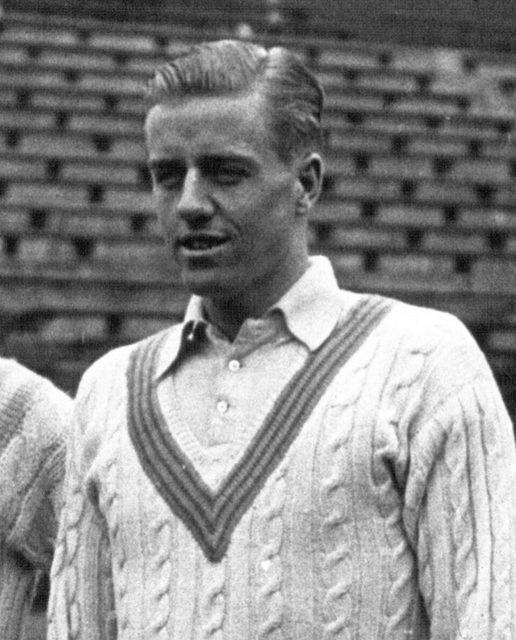
United States · born Black Rock, Connecticut, 1911 · died 2009 · right-handed · Wimbledon champion 1931, the only man to win the title without playing the final
Age at his Wimbledon debut in 1927, the youngest men's entrant in its history
19
Age when he won Wimbledon in 1931, the third youngest men's champion
W/O
The 1931 final, the only Wimbledon men's final decided by walkover
26
US Championships singles events played, second only to Vic Seixas
No. 5
World ranking in 1938
Playing career
Sidney Burr Beardslee Wood Jr. was born in Black Rock, Connecticut, on 1 November 1911 and was seriously ill for much of his childhood, with tuberculosis among other things. His uncle Watson Washburn, a Davis Cup player, taught him the game. After the family moved to Tucson he won the Arizona state championships in 1926, and in 1927, at 15, he played the French Championships and Wimbledon, where he was the youngest men's entrant on record and lost on Centre Court to René Lacoste.
Seeded seventh at Wimbledon in 1931, he beat Pat Hughes and then Fred Perry to reach the final, where his friend and Davis Cup teammate Frank Shields withdrew injured. Wood became champion at 19 without hitting a ball in the final. He beat Shields in the Queen's final in 1934, played the Davis Cup Challenge Round on Centre Court that summer, and reached the US Championships final in 1935, losing to Wilmer Allison. He kept a US top ten ranking from 1930 to 1945 and was ranked world No. 5 in 1938.
Away from the court he worked on Wall Street during the Depression, became a partner in gold mines, and invented and patented Supreme Court, a portable synthetic indoor surface used by World Championship Tennis from 1973 to 1978. He entered the Hall of Fame in 1964 and died in Palm Beach, Florida, on 10 January 2009, aged 97, the oldest living Hall of Famer.
On grass
Wimbledon 1931
Seeded seventh. Beat Pat Hughes in the quarter-finals and Fred Perry 4-6, 6-2, 6-4, 6-2 in the semi-finals; Frank Shields, hurt in his semi-final win over Jean Borotra, withdrew from the final at the request of the US Davis Cup committee
Queen's 1934
Beat Frank Shields 6-4, 6-3 in the final, the grass court win over Shields he had set himself as the condition for keeping the Wimbledon trophy
Davis Cup 1934, Centre Court
Inter-Zone final against Australia: beat Jack Crawford 6-3, 9-7, 4-6, 4-6, 6-2 to level the tie, which the United States won 3-2. Challenge Round against Great Britain: lost to Fred Perry 6-1, 4-6, 5-7, 6-0, 6-3 and to Bunny Austin 6-4, 6-0, 6-8, 6-3
US Championships
Singles final 1935 at Forest Hills: lost to Wilmer Allison 6-2, 6-2, 6-3. Doubles final 1942 with Ted Schroeder: lost to Gardnar Mulloy and Bill Talbert 9-7, 7-5, 6-1
Leading grass titles only: the grass majors, tour-level grass events since 1968 and the leading grass championships before 1968. † single source; ‡ sources disagree. Roll of champions
"she liked me, but she liked Frank more"
Anecdotes
The person behind the player.
Childhood
The garage wall
As a boy he was so often bedridden that his family feared for his life; tuberculosis was the worst of it. His health improved, and he started by hitting against the garage wall at home with a racquet he found there. His uncle Watson Washburn, a former US top five player, taught him from the age of 12.
At 15 he became the youngest man to play at Wimbledon. Dressed in white knickers, he was drawn against the top seed, René Lacoste, on Centre Court and lost 6-1, 6-3, 6-1.
Wood did not believe a walkover settled anything. He gave the trophy for safe keeping to Maud Barger-Wallach, the 1908 US champion and a friend of both players, and said he would keep it only once he had beaten Shields on grass. He did so in the Queen's final of 1934, then waited six months to get the cup back. He later wrote a book, The Wimbledon Final That Never Was.
At The Hill School in Pottstown, Pennsylvania, he invented J-ball, a cross between tennis and baseball played by teams of 11, with a tennis racquet for a bat and a tennis ball. The school still plays it.
Amateur tennis paid nothing, so he cut back his schedule, set up as a stockbroker on Wall Street during the Depression and went into business with Don Budge in a Manhattan laundry. Through Wall Street he returned to gold mining, his father's trade, and by 26 was a partner in several mines.
He invented, designed and patented Supreme Court, a portable synthetic surface for indoor tennis. World Championship Tennis used it on its tour from 1973 to 1978.